

Say your customer texts at 9 PM asking to change a delivery address. A rule-based chatbot would send them a menu of options and hope one fits. A conversational AI tool would read the message, pull up their order, and handle the change without human help. The experience looks completely different on your customer’s end, even though both are automated.
The difference between a chatbot and conversational AI comes down to the technology behind the interaction. A chatbot is a software tool that responds to customer messages using predefined rules or AI, while conversational AI is the underlying technology with natural language processing and machine learning for more advanced, human-like interactions.
Using these two together can help your business respond quickly to customer inquiries in natural language, while escalating urgent requests, or ones that require a human touch, to your team.
What to know about a chatbot vs. conversational AI
- Traditional chatbots follow scripted rules for repetitive tasks like FAQs.
- Conversational AI uses NLP and machine learning to understand intent and context, making it ideal for complex, multi-step interactions.
- Not all chatbots are conversational AI, but conversational AI can power chatbots. The overlap is where AI-powered chatbots live. These are bots that understand free-form language and improve over time.
- Choose based on customer needs: rule-based bots suit predictable inquiries, while conversational AI is better for open-ended questions and personalized, multi-channel support.
- Many businesses now combine both, using rule-based automation for simple tasks and conversational AI for everything else within the same platform.
This guide covers the differences between a chatbot vs. conversational AI and walks through examples of where each fits best across customer support, sales, scheduling, and more.
What are the differences between a conversational AI vs. chatbot?
Here’s a quick overview that compares chatbots vs conversational AI at a high level before we get into the details.
| Traditional chatbot | Conversational AI | |
| How it works | Follows scripted rules, decision trees, or keyword matching | Uses NLP, machine learning, and intent recognition to understand and respond |
| Language understanding | Recognizes specific keywords or menu selections | Interprets meaning, context, tone, and intent across free-form input |
| Response type | Pre-written answers pulled from a fixed set | Dynamic responses generated or selected based on the full conversation |
| Learning ability | Static, and responses stay the same unless manually updated | Improves over time by learning from interactions |
| Personalization | Limited, with the same response regardless of who’s asking | Can tailor answers based on customer history, preferences, and context |
| Channel flexibility | Typically limited to one channel like web chat or SMS | Works across SMS, email, web chat, voice, and messaging apps |
| Best for | FAQs, simple routing, after-hours auto replies | Complex questions, multi-step support, personalized recommendations |
| Setup complexity | Low, and quick to build with templates and decision trees | Moderate, requiring training data, knowledge base, and ongoing tuning |
| Cost | Lower upfront investment | Higher initial investment, often lower cost per interaction at scale |
The sections below go deeper into the differences between chatbots vs. conversational AI, how they overlap, and where each one fits best.
What is a chatbot?
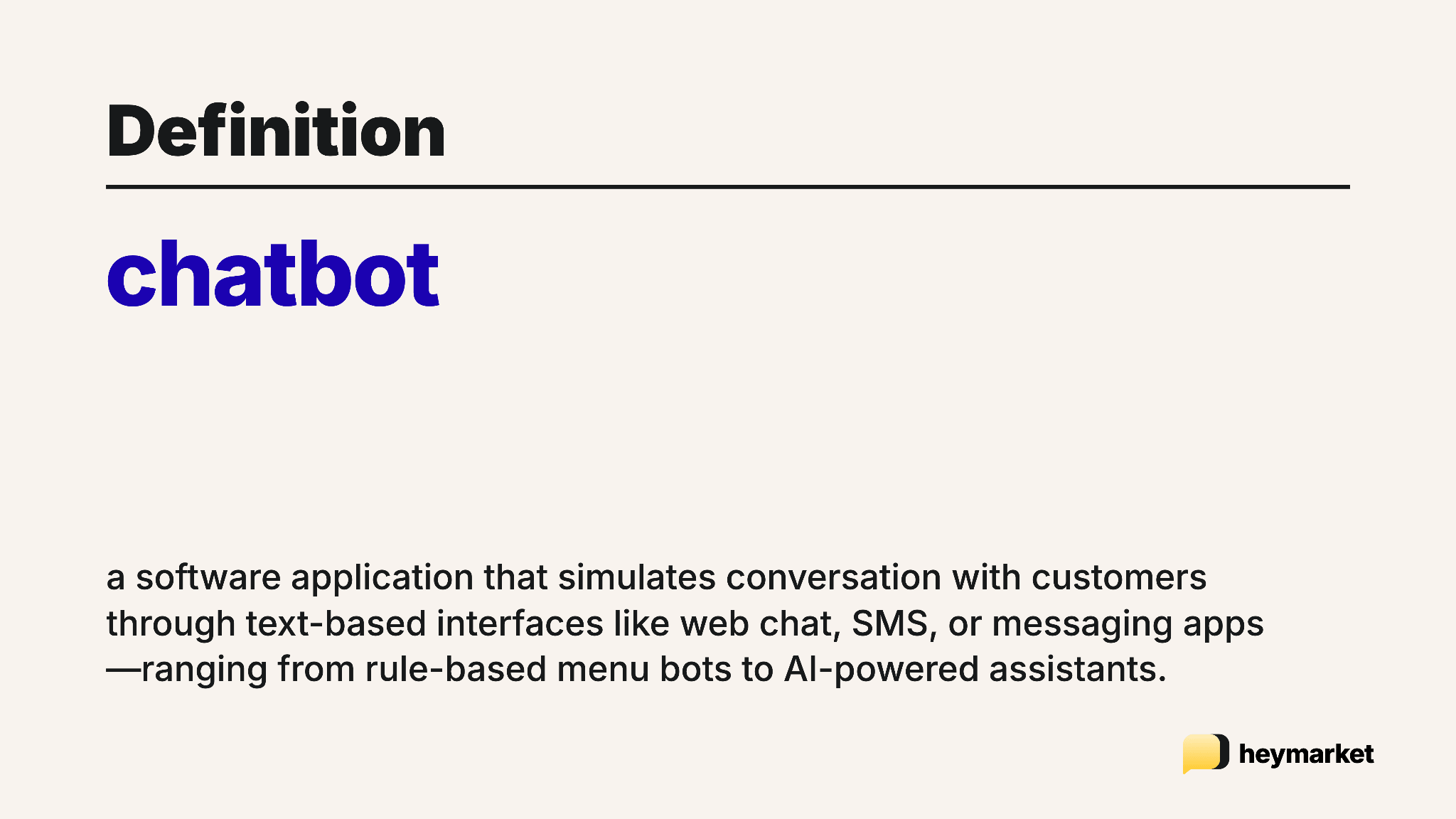
A chatbot is a software application designed to simulate conversation with your customers, usually through text-based interfaces like web chat, email, SMS, or messaging apps.
Its main job is to answer questions or complete tasks for your business without requiring a human agent. For example, a customer might text “where’s my order?” and a chatbot would pull up their tracking info and send it back in seconds on its own.
Chatbots can range from basic menu-driven bots to sophisticated AI-powered assistants. Businesses today typically use three types of chatbots, each with different levels of complexity:
- Rule-based and menu-based chatbots
- AI-powered chatbots
- Hybrid chatbots
1. Rule-based and menu-based chatbots
Rule-based chatbots operate on predefined scripts and work like a decision tree. For example, if your customer says X, the bot responds with Y. These chatbots use keyword matching, button menus, and structured conversation flows. Menu-based chatbots are a closely related variation that present users with a list of clickable options to guide them through specific tasks.
Both rule-based and menu-based chatbots handle predictable, repetitive interactions effectively, like:
- Order status checks
- Store hours
- Return policy questions
- Routing your customer to the right department
If your support team answers the same questions over and over, a rule-based or menu-based chatbot can handle most of that volume without human involvement.
The difference between this type of chatbot and others (including conversational AI) is that these bots can’t interpret questions they weren’t explicitly programmed for. If your customer phrases something in an unexpected way or asks a follow-up that falls outside the script, the bot either loops back to a generic response or escalates to a live agent.
If your team needs round-the-clock coverage for common questions, like after-hours auto replies, rule-based bots are a reliable, low-cost starting point.
2. AI-powered chatbots
AI-powered chatbots go beyond scripted responses by using natural language processing (NLP). This helps them understand what your customer is actually asking and the intent behind the message, not just the keywords they use. This type of chatbot can handle free-form text, manage multi-turn conversations, and pull from knowledge bases to generate relevant answers.
The key difference between an AI-powered chatbot and a rule-based one is adaptability. An AI SMS chatbot can field questions sent with natural language that it wasn’t explicitly programmed for, as long as it has access to the right information. It can also learn from past interactions, getting better at recognizing patterns and resolving issues over time.
3. Hybrid chatbots
Hybrid chatbots combine rule-based logic with AI capabilities in a single system. They use structured decision trees and keyword triggers for common, predictable requests while relying on NLP and machine learning to handle more complex or unexpected inputs.
This blended approach is becoming the norm. It gives your team the reliability of scripted flows for high-volume tasks—email and SMS notifications for order tracking, appointment confirmations, and basic routing—alongside the flexibility of AI for conversations that don’t fit neatly into a script. When the AI portion encounters something it can’t resolve, it can escalate to a human agent with the full conversation context attached.
Instead of choosing between a chatbot vs. conversational AI, you can turn to hybrid chatbots for a good balance of cost, complexity, and customer experience.
What is conversational AI?
Your team probably has some form of chatbot handling FAQs or auto-replies. The question is whether that’s enough or whether you need something smarter behind it.
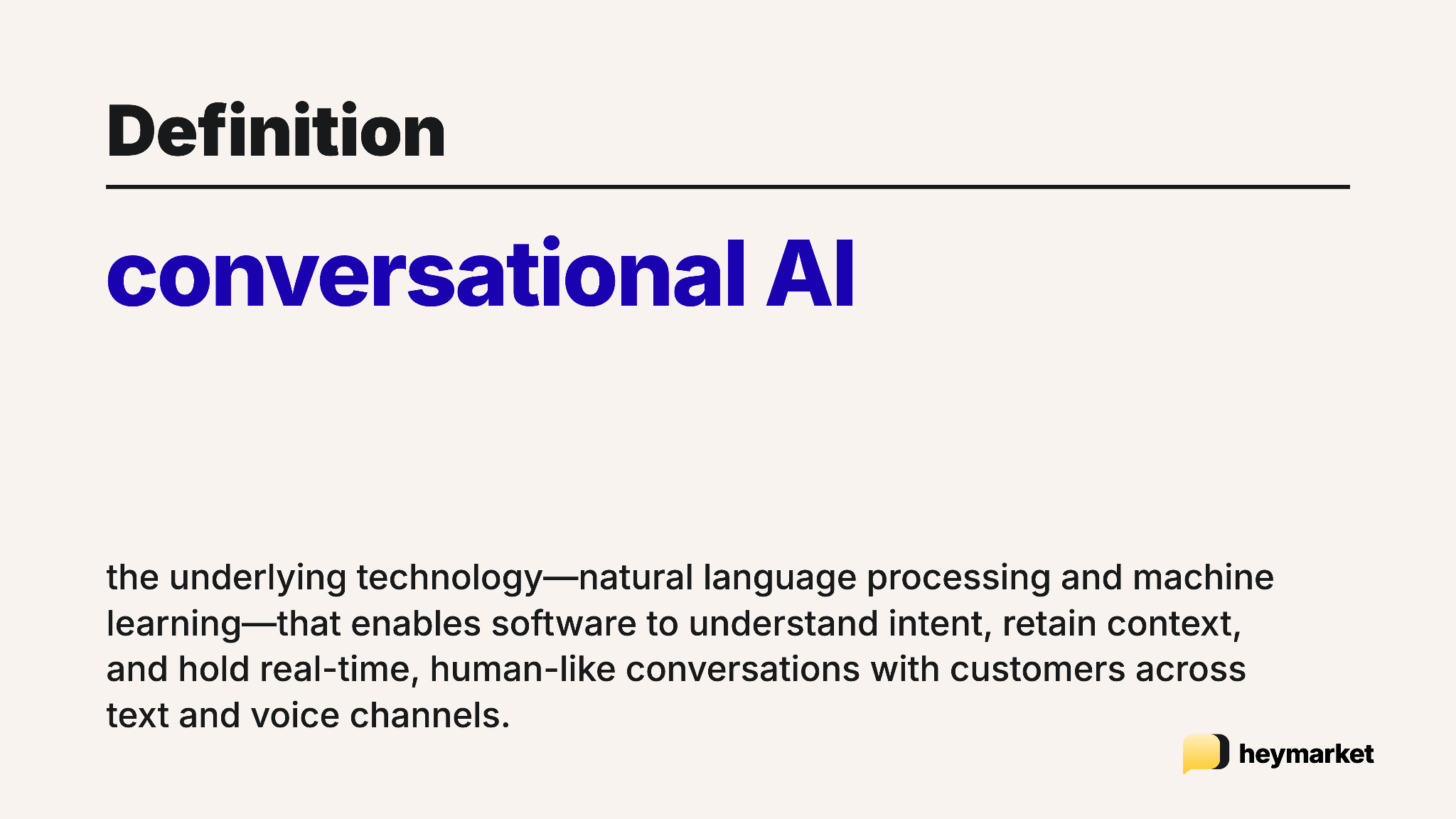
Conversational AI is the technology layer that makes human-like digital interactions possible. It’s a broader category than chatbots alone, encompassing the set of technologies that allow software to understand, process, and respond to human language in a natural way. Those technologies include natural language processing (NLP), natural language understanding (NLU), machine learning, sentiment analysis, and large language models (LLMs).
Where a chatbot is a specific application that customers interact with, conversational AI is what powers it. Conversational AI also extends well beyond chatbots into voice systems, agent-assist tools, and more.
Here’s an example of what conversational AI for customer service can look like when your customer texts your business.
Your customer sends a message asking to reschedule an appointment. Conversational AI interprets the request (even if it’s phrased casually), checks their customer history, identifies available times, and responds with options, all without a human stepping in.
A rule-based chatbot handling the same request would need the customer to follow a specific set of prompts and menu selections to reach the same outcome.
Conversational AI is great at handling ambiguity, context, and multi-step interactions. Scripted bots can’t. When you directly compare conversational AI vs chatbot examples, this gap becomes clear.
Businesses use several types of conversational AI depending on the use cases they need it for:
- AI-powered chatbots and virtual agents
- AI voice agents and voice assistants
- AI-assisted messaging tools
1. AI-powered chatbots and virtual agents
There’s a good chance you’re familiar with AI-powered chatbots. They handle text-based conversations with customers across channels like SMS, email, web chat, and messaging apps, using NLP and machine learning to understand intent and generate relevant responses. They’re a great option for conversational customer engagement, taking over tasks like sending surveys or follow-ups.
Virtual agents offer more capabilities than AI chatbots. An AI chatbot typically responds to individual questions, and a virtual agent can manage more complex, multi-step interactions. It’s the difference between a bot that recognizes the word “reschedule” and sends a link, and one that reads “I can’t make Thursday, is there anything Friday afternoon?” and actually finds a slot that works.
A virtual agent might also walk your customer through a troubleshooting process, process a return from start to finish, or qualify a sales lead by asking follow-up questions and routing the conversation based on the answers.
If you handle customer conversations across multiple types of customer service chats, AI-powered chatbots and virtual agents help maintain consistency and speed without requiring a human for every exchange.
2. AI voice agents and voice assistants
AI voice agents handle spoken conversations with customers, often replacing or augmenting traditional phone-based support. Unlike the consumer voice assistants most people know (Siri, Alexa, Google Assistant), business-focused AI voice agents are built specifically for customer interactions. They can answer questions, process requests, and route calls, all through natural spoken language rather than touch-tone menus.
AI voice agents and voice assistants work especially well if your business has high call volumes. An AI voice agent can handle routine calls (checking account balances, confirming appointments, providing order updates) while routing complex issues to a live agent with context already gathered from the conversation.
The technology has improved significantly in recent years, with modern AI voice agents recognizing intent, detecting emotion, and even handling real-time translation across languages.
3. AI-assisted messaging tools
AI-assisted messaging tools work with human agents rather than replacing them. Instead of handling the full conversation with your customer, AI-assistant messaging tools help support and sales teams work faster and more consistently.
AI-assisted messaging tools can:
- Suggest replies based on a knowledge base
- Translate messages in real time
- Summarize long conversation threads
- Adjust overall message tone
For teams managing high volumes of conversational messaging across SMS, email, and chat, AI-assisted tools reduce response times and help newer agents ramp up faster.
Heymarket’s AI-powered texting tools are an example of this type of conversational AI. They work within the team’s shared inbox to suggest replies, translate messages, and help agents draft responses more quickly, without taking the conversation away from the human entirely.
How do chatbots and conversational AI overlap?
Chatbots and conversational AI do overlap, but while chatbots are a type of conversational AI, not all chatbots use conversational AI technology.
- A rule-based chatbot that walks customers through a menu of options is an automated script, not conversational AI.
- An AI-powered chatbot that understands free-form language, recognizes intent, and generates contextual responses is conversational AI in action.
The confusion between a chatbot vs. conversational AI comes from the fact that many modern chatbots sit somewhere in the middle. A chatbot might use basic NLP to interpret simple messages but fall back on decision trees for anything complex. Some platforms blend rule-based automations with AI, using keyword triggers for common requests and AI for everything else.
How much intelligence your chatbot needs should be taken into consideration when you’re evaluating conversational AI vs. chatbot features. The answer depends on what your customers are asking for and how many channels you’re supporting.
If most of your inbound volume involves common questions like order updates, store hours, and appointment confirmations, a well-built rule-based chatbot does the job. If your customers ask open-ended questions, need personalized recommendations, or reach out across SMS, email, and web chat, you’ll need a solution with real conversational AI behind it.
Understanding the differences between omnichannel chatbots vs. business texting can help clarify which approach fits your communication strategy.
When should you use a chatbot vs. conversational AI?
Salesforce’s 2025 State of Service report found that AI now handles 30% of service cases—projected to reach 50% by 2027—and reps using AI spend 20% less time on routine interactions. Making the right choice between chatbots vs. conversational AI can help your team achieve similar efficiency gains.
Is your team fielding the same five questions every day about shipping costs or holiday hours? Or could every conversation go in a different direction that no keyword trigger would be able to help with?
Here’s what works best for each scenario and how both can work together.
1. Use a rule-based chatbot when your inquiries are predictable
As we mentioned earlier, if your support volume is filled with questions like business hours, return policies, shipping timelines, and account status, a rule-based chatbot handles that efficiently. It’s fast to set up, inexpensive to maintain, and frees up your team for conversations that actually need a human.
Rule-based bots also work well as a first layer of triage. They can collect basic information (name, order number, issue type) and route the conversation to the right agent or department, so when your agent picks up the conversation, they already know it’s a billing issue for order #4821 instead of starting from scratch. This cuts down on back-and-forth before a human even gets involved.
2. Use conversational AI when interactions are complex or varied
When customers ask open-ended questions, need help comparing options, or have issues that span multiple topics, conversational AI handles those interactions more effectively than certain chatbots. It can understand the full context of a conversation, pull relevant information from a knowledge base, and respond in a way that feels natural rather than scripted.
Conversational AI also shines in sales and lead qualification. Instead of pushing prospects through a rigid form, an AI-powered assistant can ask follow-up questions, recommend products based on what the customer describes, and route qualified leads to a sales rep with full context attached.
For customer service teams handling support across multiple channels, conversational AI helps maintain consistency. If your customer reaches out over email, SMS, web chat, or WhatsApp, the AI can pull from the same knowledge base and customer history to deliver a coherent experience.
If your team runs on Salesforce or HubSpot, use conversational AI that’s native to the platform—or is part of a powerful integration. That way, context from every text or email stays in the CRM automatically, not siloed in a separate tool.
3. Use both when you need scale and flexibility
There might be some situations where your customer sends a long, detailed email about a billing error or product issue and expects an immediate response. A rule-based chatbot fires off an auto-reply confirming receipt so they’re not left wondering if it sent properly. At the same time, conversational AI summarizes the thread, flags the key issue, and drafts a response your agent can review and send.
That’s what it looks like when you layer both rather than choosing between chatbots vs. conversational AI. Rule-based automations handle the high-frequency tasks like keyword triggers, auto-replies, and routing, while conversational AI picks up the conversations that need more nuance.
This is especially common for omnichannel messaging where teams manage SMS, email, web chat, and messaging apps from a single inbox. It keeps everything moving along without your agents getting overwhelmed.
Comparing a chatbot vs. conversational AI by use case
Certain use cases work better for integrating conversational AI vs. chatbot capabilities and vice versa. Some business functions run fine on scripted automations, while others need the flexibility of AI. Here’s how each technology maps to common use cases.
1. Customer support
Rule-based chatbots work well for frontline customer support triage. They can answer FAQs, check order statuses, share return policies, and route customers to the right department based on their issue type. For teams that need after-hours coverage, a scripted auto-reply chatbot keeps customers up to date until business hours.
Conversational AI fits better when support requests are unpredictable or involve multiple steps. An AI-powered virtual agent can walk your customer through a troubleshooting process, pull account details to answer billing questions, or summarize a long conversation thread before handing it off to a live agent.
Teams using AI for customer service across SMS, email, and chat often rely on conversational AI to maintain fast, consistent responses at scale.
2. Sales and lead qualification
A rule-based chatbot can capture lead information through structured forms, ask qualifying questions from a set list, and route prospects to the appropriate sales rep. This type of chatbot is effective when the qualification criteria are clear and the process follows a predictable path.
Conversational AI adds more depth to sales interactions and acts more like an AI-powered assistant. It can engage prospects in a natural back-and-forth, ask follow-up questions based on their answers, recommend products that match what they describe, and pass qualified leads to a rep with full conversation context.
Your team can use AI for sales to shorten the path from inquiry to conversation with a human.
3. Appointment scheduling and reminders
This is one area where rule-based chatbots perform especially well. Appointment confirmations, reminders, and rescheduling prompts follow a predictable pattern that’s easy to automate with keyword triggers and templates. A customer texts “confirm” or “reschedule,” and the bot responds with the right next step.
Conversational AI becomes useful when the scheduling interaction gets more complex, like when your customer asks for the earliest opening at your downtown location for Thursday afternoon, or when the system needs to check availability across multiple locations or providers before responding.
4. Order updates and delivery notifications
Automated, rule-based messages handle this use case efficiently. System events trigger shipping confirmations, delivery ETAs, and delay notifications and are sent over SMS or email without any AI involved. These are high-volume, low-complexity messages that benefit from simple automation.
Conversational AI comes into play when your customer responds to one of those notifications with a question. If someone replies to a delivery update asking to change the delivery address or wants to know why their package is delayed, an AI-powered bot can interpret the request and respond without needing a human agent.
5. Internal team productivity
Conversational AI isn’t limited to customer-facing use cases. AI-assisted messaging tools help support and sales agents work faster by suggesting replies, translating messages in real time, and adjusting tone with a single click.
Say a customer texts in Spanish about a delayed order. Instead of your sales agent switching to a translation app, copying the message, drafting a reply, and translating it back, the conversational AI handles all of that inside the conversation thread.
This reduces response times and helps maintain consistency for teams managing high conversation volume across multiple channels. This can speed workflows up considerably, especially during peak periods or when onboarding new agents.
Choosing the right AI approach for your business
Choosing between a chatbot vs. conversational AI depends on what your customers are asking, how many channels you’re covering, and how complex those conversations get. Teams getting the most out of chatbots and conversational AI are typically layering both, automating the predictable interactions and applying AI where flexibility and context make a real difference. The right platform makes that easy to set up without stitching together separate tools.
Heymarket’s AI-powered texting tools bring both into a single omnichannel platform so you can start simple and scale as your needs grow. Book a demo or start a free trial to see how automations and conversational AI can help your team today.
Chatbot vs. conversational AI FAQs
As you start evaluating customer communication tools, it’s helpful to understand the differences between a chatbot vs conversational AI. Here are answers to questions we get asked the most about how the two relate, and when it makes the most sense to use one or both.
Can a chatbot be conversational AI?
A chatbot can be conversational AI if it uses technologies like natural language processing and machine learning to understand and respond to customer messages. Rule-based chatbots that rely on scripted menus and keyword matching aren’t conversational AI. The distinction between chatbots vs conversational AI comes down to whether the bot can interpret free-form language and adapt its responses based on context.
Is conversational AI better than a chatbot?
Conversational AI handles more complex, varied interactions than a basic chatbot, but “better” depends on what you need. For predictable, high-volume questions like store hours or order status, a rule-based chatbot is fast and cost-effective. For open-ended questions, personalized support, or multi-channel conversations, conversational AI delivers a more natural and accurate experience.
What’s an example of conversational AI in customer service?
An example of conversational AI in customer service is an AI-powered texting assistant that reads your customer’s message about rescheduling a delivery, understands the request without requiring the customer to select from a menu, checks available options, and replies with alternatives within the same text thread. Unlike a scripted bot, it handles the conversation naturally and can escalate to a human agent if the issue gets more complex.
Do businesses need both a chatbot and conversational AI?
Many businesses use both when comparing chatbot vs conversational AI for their needs. Rule-based automations handle simple, repetitive tasks like auto-replies, keyword routing, and appointment confirmations. Conversational AI picks up the more nuanced conversations, answering open-ended questions, drafting personalized responses, or assisting agents in real time. Layering both gives teams the efficiency of automation with the intelligence of AI.