


Your sales rep opens a lead record, finding a name and email address but nothing about the company, their role, or the context around what the person actually needs. So your rep opens LinkedIn in another tab, cross-references the company website, guesses at the job title, and types it all in manually. Multiply that by fifty new leads a week, and your team is spending hours piecing together contact info and data entry. Now, AI data enrichment makes it possible to gain complete, actionable customer records without the constant back-and-forth research.
AI data enrichment is the process of using artificial intelligence (AI), including machine learning, natural language processing, and large language models, to automatically improve and expand your existing business data. Instead of manually updating contact records or cross-referencing spreadsheets, AI runs in the background to identify gaps, infer missing details, and add context to the information you already have. The result is cleaner, more complete data that your team can actually act on, rather than fragments they have to piece together.
Using AI for data enrichment: key takeaways
- AI data enrichment uses machine learning to fill in missing CRM fields, standardize records, and add context like sentiment or intent, all without manual effort from your team.
- It differs from data augmentation, which creates synthetic data to train ML models rather than improving real business records.
- Teams in sales, marketing, healthcare, logistics, and retail use data enrichment AI to personalize outreach and keep customer records accurate.
- Challenges include data quality from external sources, privacy compliance, and the need for ongoing validation as records change over time.
What is AI data enrichment, and why use it?
If you’ve ever inherited a CRM full of half-filled contact records, you already know the problem AI data enrichment solves. It takes the data you have and makes it useful without needing you or your team to spend time reviewing and updating it.
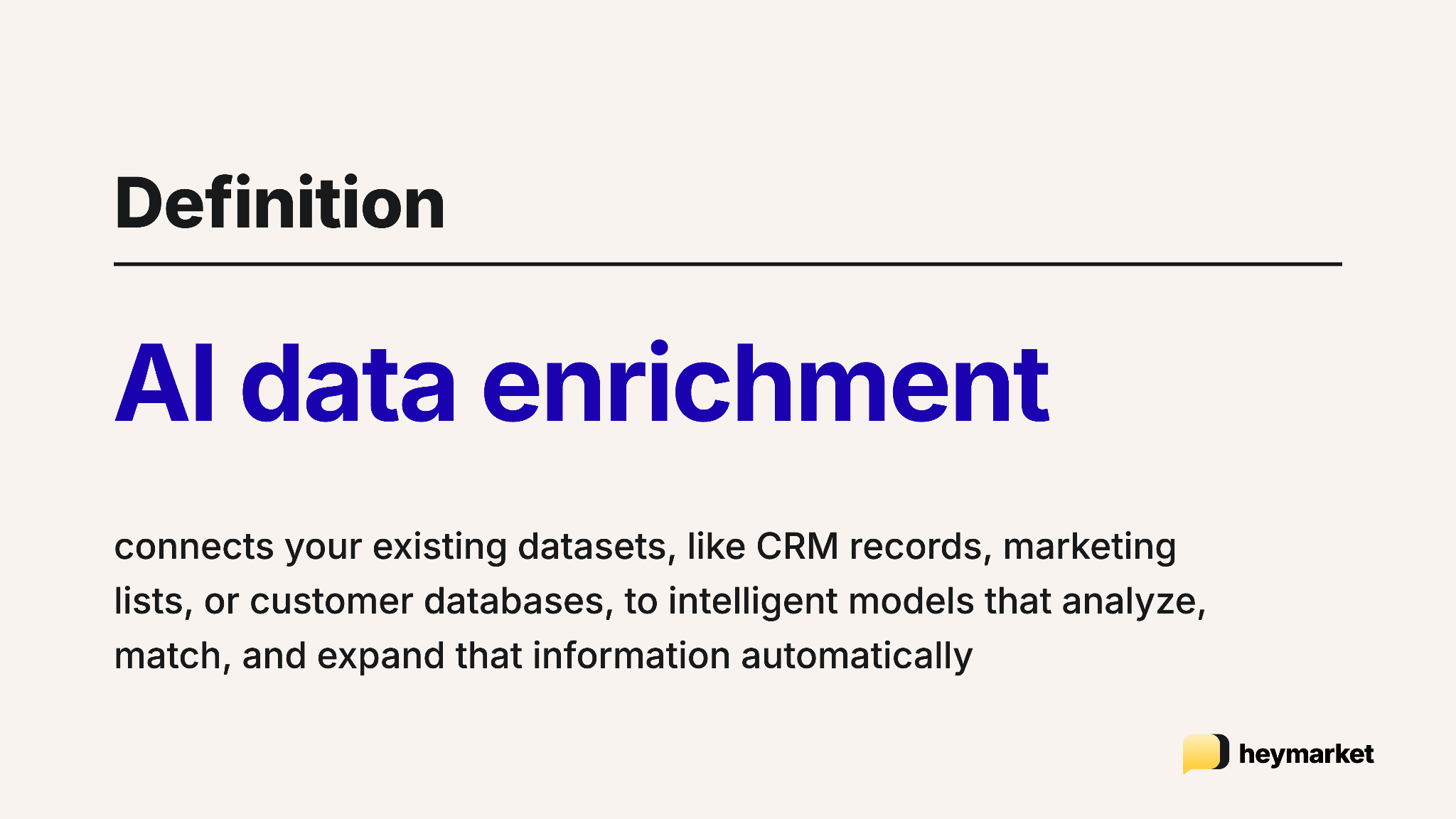
Data enrichment AI connects your existing datasets, like CRM records, marketing lists, or customer databases, to intelligent models that analyze, match, and expand that information automatically. This process helps your team get complete records without manual research, and your campaigns get better targeting without guesswork.
How does AI data enrichment work?
AI data enrichment works by running your records through a series of intelligent machine learning and NLP processes that clean, connect, and expand them. It takes the process that your team would normally take time doing and turns it into an automated workflow.
Here’s what the process might look like:
- Entity matching: AI compares records across systems to identify duplicates and link related entries. If the same contact appears in your CRM with slightly different formatting (“Robert Smith” vs. “Bob Smith, Acme Corp”), the model resolves these into a single accurate record.
- Inferring missing attributes: When a contact record is missing key fields like job title, company size, industry, or location, AI can infer these based on patterns in your existing data and publicly available information. A lead who fills out a form with just an email and company name can have their record expanded with role, department, and firmographic details.
- Sentiment and intent analysis: AI reads unstructured text, things like support conversations, email replies, and form submissions, and tags records with sentiment scores or purchase intent signals. If a lead’s recent messages suggest an unhappy experience or high buying interest, the model attaches that context to their profile automatically.
- Classification and scoring: Models can categorize contacts by lifecycle stage, score leads based on engagement patterns, or tag conversations by topic. These enriched fields feed directly into your routing rules, campaign triggers, and segmentation.
- Lead enrichment from conversations: Some data enrichment platforms with AI go further by extracting enrichment data from live conversations. For example, Heymarket’s AI agent feature captures details like name, provider preference, and location directly from inbound messages, then logs them to your connected CRM automatically. If a patient texts that they need a follow-up with a specific doctor in Raleigh, the agent picks that up and uses it to personalize the next reply.
Unlike older enrichment methods, AI doesn’t just append static data from a purchased list. It learns patterns, processes unstructured information, and updates records continuously as new data flows in.
What does a data enrichment AI feature look like in action?
Say a new patient texts your clinic: “Hi, I need to schedule a follow-up appointment with Dr. Patel. I’m in the Raleigh area and my insurance is Blue Cross.”
Before AI data enrichment, that patient’s record in your system might contain a phone number and nothing else. Your front desk staff would need to manually log the name, note the provider preference, confirm the location, and verify insurance details before they could even start scheduling. That’s several minutes of admin work, all for a single reply.
With a platform that has data enrichment AI features running in the background, here’s what happens instead:
- The lead enrichment agent parses the conversation: It picks up that the patient is requesting a follow-up, prefers Dr. Patel, is located in Raleigh, and has Blue Cross insurance. Those details get logged to the CRM record automatically.
- Missing profile fields get filled in: Based on the contact’s phone number and existing records, AI appends their full name, date of birth, and any prior visit history already in the system.
- The conversation gets personalized instantly: Because the agent captured the patient’s provider preference and location, the next message can be tailored right away: “Hi Maria, I can see you’re looking for a follow-up with Dr. Patel at our Raleigh office. We have openings next Tuesday and Thursday. Would either of those work?”
- The record is tagged and routed: AI classifies the inquiry by type (follow-up appointment, returning patient) and routes it to the appropriate scheduling queue so your team can prioritize accordingly.
All of that happens in seconds, without your staff toggling between tabs or typing anything into your CRM. The conversation moves forward with context, and your patient records stay clean from the first interaction.
AI data enrichment vs. data augmentation
These terms get mixed up a lot, but they solve very different problems.
AI data enrichment improves real business records by adding missing context. Think: appending a company’s industry to a lead record, or tagging a conversation with a sentiment score. You’re working with actual customer and prospect data, making it more complete and useful for sales, marketing, and operations.
Data augmentation creates synthetic data to expand a training dataset for machine learning models. If you’re building a model to detect spam messages but only have 500 examples, augmentation generates thousands of variations, so the model trains more effectively. It doesn’t add real-world information to your records.
Enrichment matters more for most teams that heavily rely on CRMs in their workflows. Your marketing team, for example, needs accurate contact records so your drip campaigns reach the right people with relevant messaging.
How is AI data enrichment used across industries?
AI data enrichment helps any team that depends on accurate, up-to-date records to personalize outreach and operations.
Here’s how it works across three broad industries:
1. Healthcare and patient communications
Healthcare organizations use enrichment to keep patient records consistent across scheduling systems, EHRs, and communication platforms. AI can standardize names, merge duplicate records, and flag outdated contact information. That accuracy is critical when you’re sending appointment reminders or follow-up instructions through SMS and email.
Enriched records with accurate lifecycle stages and engagement history also help your marketing team run more relevant patient outreach. Automated messages and email workflows for wellness check reminders or seasonal flu shots reach the right patients, instead of blasting a generic message to your entire list.
2. Logistics and delivery operations
Logistics teams deal with high volumes of time-sensitive customer data, from shipping addresses to delivery preferences. AI data enrichment keeps those records clean across systems, so your team can send accurate tracking updates, route delivery notifications to the right contact, and catch address errors before they cause failed shipments.
3. Retail and e-commerce
Retailers enrich purchase and browsing data with inferred preferences and predicted intent. AI can identify which customers are likely to churn, which are ready for an upsell, and which segments respond best to specific messaging channels. That enriched data feeds directly into campaign targeting and customer retention workflows.
For retail sales teams, AI can enrich firmographic data with company size and revenue for B2B accounts. AI can also score leads based on behavioral signals like browsing history and cart activity to help your team prioritize high-intent buyers instead of researching each one manually. Platforms with AI-powered sales tools combine enriched data with automated outreach for faster pipeline movement.
What to look for in an AI data enrichment approach
Your data enrichment setup should match how your team’s lead management actually works, which might take some trial and error.
Here are a few areas to think about when it comes to your needs, compliance requirements, and overall workflow:
- CRM and platform integration: Your enrichment process needs to connect directly to the systems your team already uses, whether that’s your Salesforce CRM, email, a messaging channel like Instagram, or a marketing automation tool. If enriched data sits in a separate warehouse and never makes it back to the tools where your team works, it won’t change outcomes. Look for bidirectional sync so enriched fields appear where reps and marketers actually see them.
- Real-time vs. batch processing: Some use cases need enrichment to happen the moment a new lead enters your system, while others are fine with nightly batch runs. Consider which records need immediate context (like inbound leads hitting a routing rule) versus which can wait (like quarterly database cleanup).
- Privacy and compliance: Any AI data enrichment process that pulls external data or processes customer conversations needs to respect regulations like GDPR, CCPA, and HIPAA. Confirm how the tool you’re researching handles consent, data residency, and PII minimization, especially if you’re enriching records in healthcare or financial services.
- Data quality validation: AI enrichment requires data from an accurate source. Low-quality third-party data or outdated models can degrade your records rather than improve them. Keep your data clean with confidence scoring, human review for edge cases, and ongoing monitoring to catch drift over time.
Tools that combine data enrichment with AI features for conversation analysis, like extracting intent from customer texts or summarizing support threads, add another layer of context that static data providers can’t match.
Keeping enriched data accurate over time
AI data enrichment isn’t a one-time project. Information always needs to be updated because people change jobs, companies get acquired, and customers move. The data enrichment process needs to run continuously by flagging outdated records and re-enriching them as it notes changes.
Platforms that combine enrichment with AI texting tools can close the loop even faster, using enriched data to personalize automated messages while feeding conversation outcomes back into the enrichment model. Your process might need updating over time as you start seeing how it handles real customer data.
Here are 3 tips to use when reviewing and refining your enrichment workflow:
- Set confidence thresholds for enriched fields so that if a model isn’t certain about an appended attribute, it flags the record for review rather than writing it automatically.
- Schedule periodic backtests where you compare enriched data against known ground truth.
- Monitor for model drift—if the accuracy of inferred fields starts declining, it’s time to retrain or swap data sources.
Making AI data enrichment work for your team
AI data enrichment turns incomplete, fragmented records into data your team can trust and act on, whether that means routing a lead to the right rep, sending a perfectly timed campaign, or flagging a customer who needs attention. It’s moved well beyond basic list appending into continuous, intelligent data improvement that adapts as your business grows.
For teams already using omnichannel messaging to connect with customers across SMS, email, and chat, enrichment adds the missing layer: knowing exactly who you’re talking to, what they need, and when to reach out. That context separates a generic blast from a message that lands at the right time, with the right information.
If you’re ready to improve your data enrichment process with AI, Heymarket’s AI Agents can help. Book a demo to learn more about how it works, or test out the features with a free trial.
FAQs about AI data enrichment
AI data enrichment touches a lot of moving pieces, from CRM integrations to privacy regulations to data accuracy. You might have additional questions about privacy, compliance, and integrations during your research.
What’s the difference between AI data enrichment and traditional data enrichment?
AI data enrichment uses machine learning to infer, classify, and match data automatically, while traditional enrichment typically appends static fields from purchased third-party databases. AI can process unstructured data like conversation text, adapt to patterns over time, and update records continuously, making it more dynamic and accurate than manual or rule-based approaches.
How does AI data enrichment handle privacy and compliance?
AI data enrichment platforms should adhere to regulations like GDPR, CCPA, and HIPAA by minimizing PII exposure, supporting data residency requirements, and providing audit trails. Look for tools that let you control which fields get enriched, set consent-based processing rules, and anonymize data where required.
Can AI data enrichment integrate with my existing CRM?
Yes, most AI enrichment tools connect to major CRMs like Salesforce and HubSpot through APIs or native integrations. The best setups offer bidirectional sync, meaning enriched data flows back into your CRM where your team actually works, and new CRM data triggers fresh enrichment automatically.
How do I know if my enriched data is accurate?
Accuracy of enriched data depends on source quality and model confidence. Look for enrichment tools that provide confidence scores for each appended field, support human review for uncertain records, and offer monitoring dashboards to track accuracy over time. Regular backtesting against known data helps catch drift before it affects your outreach.