


Links can do more than just open web pages. An SMS URL, or SMS link, is a clickable link that opens the messaging app with a phone number, and often a message, already filled in.
These click-to-text links start a new conversation the moment someone taps them, so customers can reach your team quickly and your team can reach contacts just as easily.
Here’s what they are, how to set them up, and how to use them.
Key takeaways
- An SMS URL (or SMS link) is a clickable link that opens a phone’s messaging app with the number, and often a message, already filled in.
- On a technical level, the link is built with the sms: scheme. Adding a body parameter pre-fills the message, and using both ?body= and &body= separators keeps it working on Android and iOS.
- SMS links work best on phones, which is why they belong on contact pages, calls to action, email signatures, and anywhere a customer is ready to reach out.

Learn more ways to streamline your customer service with texting.
Read the handbookWhat is an SMS URL?
An SMS URL is a type of hyperlink, sometimes called a click-to-text link. A standard hyperlink points to a web page, whereas an SMS link points to the messaging app. When someone taps it on their phone, their texting app opens with the destination number and a pre-written message already in place, ready to send.

That difference makes text message links useful. Instead of routing someone to a contact form or a number they have to copy out by hand, you hand them a conversation that’s already started. And the easier it is to reach out, the more likely it is that they will.
“SMS link” vs. “link in an SMS”
These sound alike but point in opposite directions. An SMS link lives on a web page or email, and tapping it opens a text message. A link in an SMS is the reverse: a web address inside a text you send, which opens a web page when tapped. This article is about the first kind, the link that starts a text.
How an SMS link works
Now, let’s get technical. An SMS link is built on the “sms:” URI scheme—the same mechanism behind the “mailto:” links that open a blank email. But instead of pointing to a web address, it tells the phone to open its messaging app and load a specific number and message.
A basic SMS link is made up of the SMS scheme followed by a phone number.
Tapping the following opens a new message to that number with an empty body:
sms:+15551234567
To pre-fill the message, add a body parameter:
sms:+15551234567?body=Hi%2C%20I%20have%20a%20question
Use the full international format for the number so the link works regardless of where the recipient is. The text after body= must also be URL-encoded, which means spaces become %20, a comma becomes %2C, and so on.
Most website builders encode this automatically when you paste in plain text, but if you’re writing the link by hand, encode the message first.
There’s also a catch—iOS and Android don’t use the same separator. Android expects ?body=, while iOS expects &body=.
A link hard-coded with one separator won’t behave identically on every device, so most developers detect the operating system and swap the separator for individual users, or use a click-to-text tool that handles the compatibility automatically.
How to create an SMS link
Depending on what you’re using the link for, you’ll either write it into a web page with HTML or use a click-to-text Chrome extension to text from your browser.
Creating an SMS link with HTML
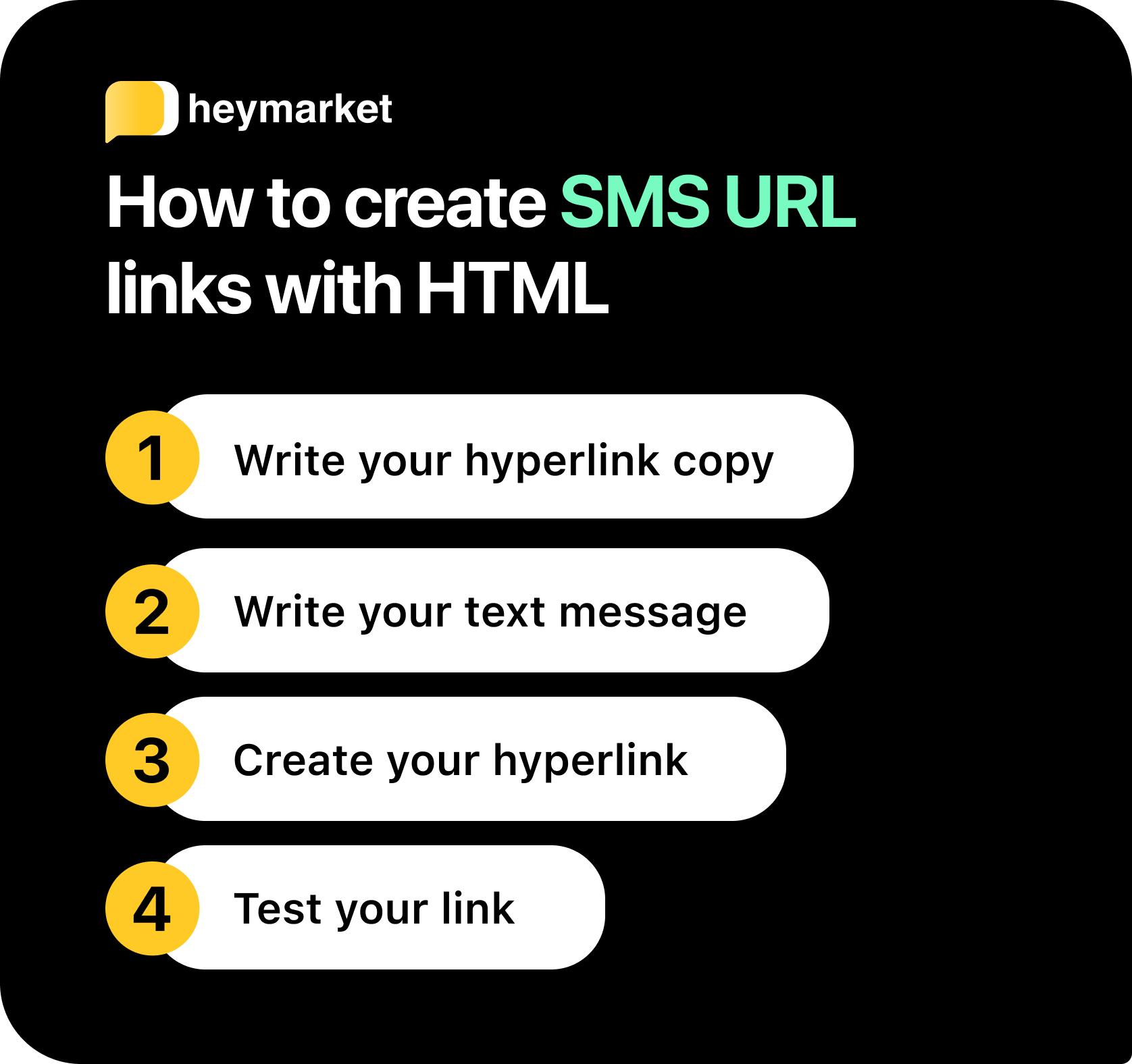
You don’t have to be a developer to do this, but you will have to drop a small piece of HTML into your page or use your site builder’s link tool.
- Write your link text. This is what visitors see and tap, like “Click here to text our team” or “Text us with a question.”
- Write the prefilled message. Decide what should be waiting in the customer’s app when it opens. Match it to the page: a support page might use “Hello, I have a question,” while a gift concierge page might use “Hi! Can I connect with a shoe fit expert?” Leave the body off if you’d rather the customer start fresh.
- Build the link. In a CMS like WordPress, you’ll use the link button (the chain icon) and paste the sms: link into the URL field instead of a web address. Include the country code (+1 for the US and Canada).
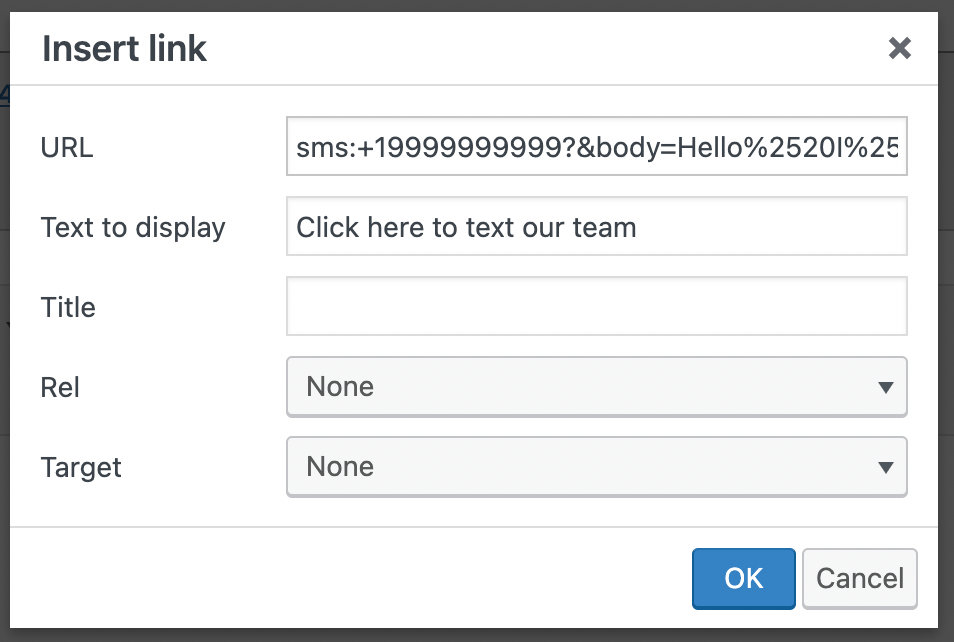
 If you’re editing HTML directly, set the href to the SMS link from the section above. Since Android reads ?body= and iOS reads &body=, the most reliable approach, without auto-detection, is to include both separators so the message pre-fills on either platform:
<a href="sms:+19999999999?body=Hello%2C%20I%20have%20a%20question&body=Hello%2C%20I%20have%20a%20question">Click here to text our team</a> - Test the link on a phone. Tap it on both an iOS and an Android device if you can, and confirm the number and message load correctly.
Once it’s live, replies will land in your shared inbox alongside your other conversations.
Using a click-to-text Chrome extension
An SMS link on your site is for your customers. If you want your own team to text any number they come across in a browser, a click-to-text Chrome extension is the easier route. It’s also how click-to-text works inside a CRM, since a phone number in a Salesforce or HubSpot record is just a number in your browser.
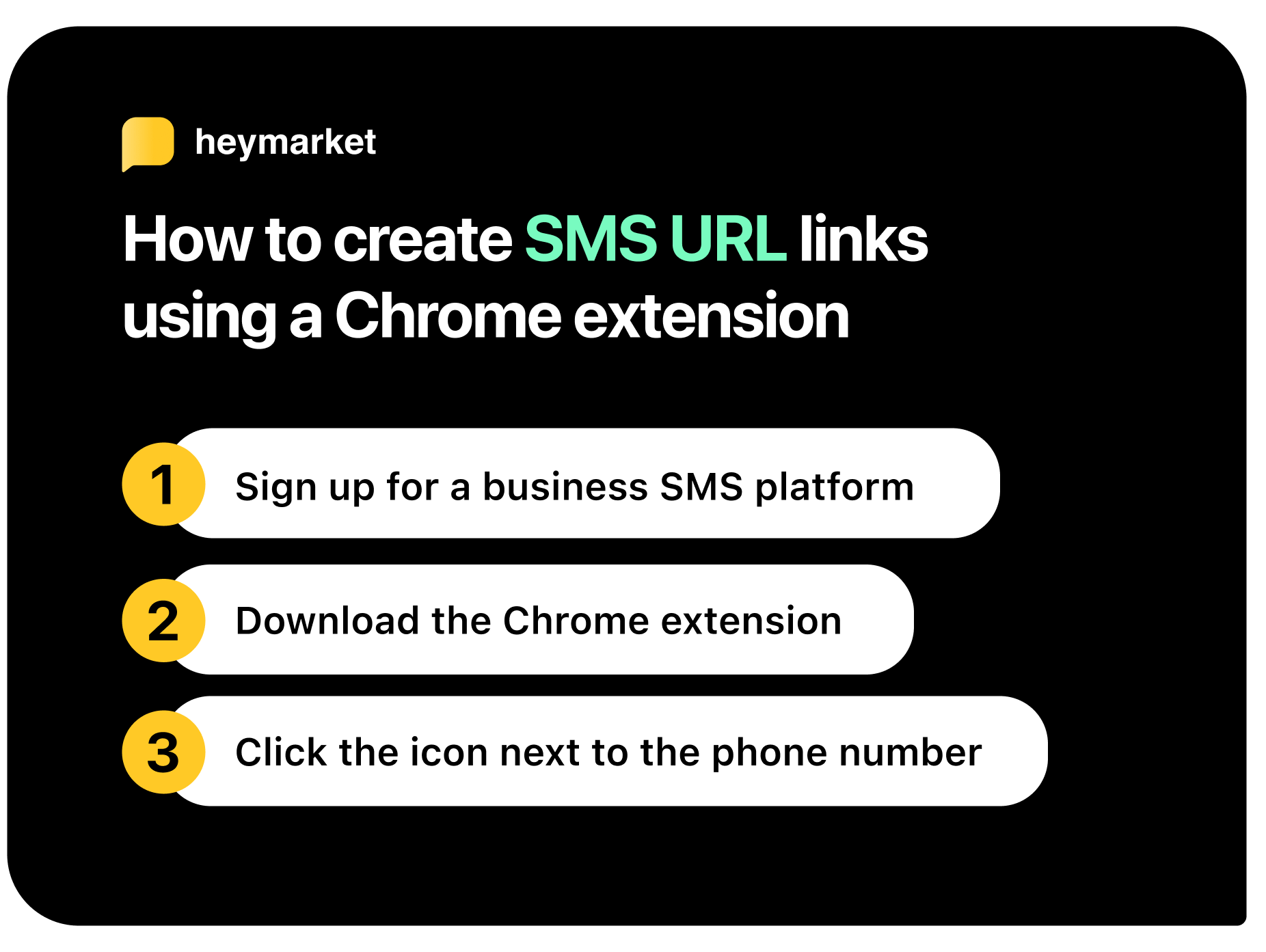
The extension works alongside your business texting platform, so you’ll need one of those first.
- Sign up for a business texting app that offers click-to-text.
- Find a click-to-text extension in the Chrome Web Store, click Add to Chrome, and follow the prompts.
- Click any phone number in your browser. A side window opens so you can text the contact and track the conversation, which syncs to your shared inbox.
From there, texting a contact is a single click, no matter which tab you found their number in.
Ways to use SMS links
There are two things to sort out with an SMS link: what you want it to do, and where you put it.
How you can use SMS links
SMS links work anywhere you want to turn interest into a conversation without making someone dial a number or fill out a form. A few of the most common include:
- Customer support: a link on your help page lets a customer text a question the moment they have one.
- Marketing and promotions: a click-to-text link on a campaign lets readers opt into a conversation with one tap.
- Sales follow-up: a link in a proposal or email signature lets prospects reply on their own schedule.
- Appointment confirmations: a prefilled “confirm my appointment” message lets clients respond instantly.
- Texting from your CRM: in Salesforce or HubSpot, click-to-text turns any number in a record into a conversation.
Each of these use cases saves time, encouraging customers to reach out more often and helping staff communicate more efficiently at scale with ready-made texts.
Where to place SMS URL links
Once your link works, put it where people are already thinking about reaching out:
- Your contact page, next to the number you already list.
- Calls to action, on any button inviting people to get in touch.
- Email signatures, so every message carries a one-tap reply.
- QR codes and print, so someone can scan a sign and land in a prefilled text.
- Social profiles, where a bio link is often the only contact method available.
Wherever it goes, make it clear the link opens a text. People expect a link to load a web page, so a label like “Text us” sets the right expectation and keeps the tap from feeling like a surprise.
Make texting the easy way to connect
A single SMS link is the simplest way to invite a text, and for a lot of pages it’s all you need. But once customers start reaching you this way, it’s worth making the channel easy to scale on your side too.
A website widget puts a click-to-text button in the corner of any page, so customers can start a conversation without hunting for a link or leaving what they’re reading. And SMS integrations connect texting to the CRM or help desk your team already works in, so every reply lands in one place instead of scattered across inboxes and personal phones.
The link is where it starts. For the rest, our SMS Customer Service Handbook covers how to build customer conversations around texting.