


A truck breaks down twenty minutes from a delivery window. That’s a logistics problem, but it becomes a dispatch problem fast: someone has to find a replacement driver, reroute the load, and notify the customer, all before the delay compounds. Most teams still do that manually, holding three separate conversations for one disruption.
AI agents for logistics use machine learning and natural language processing to manage shipping and supply chain work on their own without a person triggering every step.
Paired with a shared inbox built for logistics, dispatch AI agents can catch a disruption, coordinate with the driver, and keep the customer updated in one thread instead of three, cutting the manual back-and-forth out of the response.
Key takeaways about AI agents for logistics
- AI agents handle high-volume logistics tasks like shipment tracking, delivery updates, and exception handling while humans remain in control of complex cases.
- Unlike traditional automation, AI agents interpret context and adapt to exceptions in real time instead of failing or escalating every one to a person.
- Most teams start with one or two high-volume workflows and expand based on what’s working.
This guide covers what AI agents in logistics do, how they’re not like the automations you already run, where they deliver the clearest returns, and how to put them to work.
What are AI agents in logistics?
An AI agent is a software system that takes a goal, decides the steps to reach it, acts across your connected systems, and adapts when something changes. All without waiting for your team members to start each move.
In dispatch and logistics, an agent can track a shipment, notice a delay, rebook or reroute it, and notify your customer in one continuous workflow.
These benefits are attracting attention from businesses big and small. Gartner expects 40% of enterprise applications to integrate task-specific AI agents by the end of 2026, up from less than 5% in 2025. At the same time, Fortune reported, Uber Freight runs a platform of more than 30 AI agents managing roughly $20 billion in freight.
These numbers show that AI agents for logistics purposes are only going to be more popular in the coming years.
How AI agents differ from traditional logistics automation
AI agents handle what traditional logistics automation systems can’t. They interpret the current state of your operation, reason, and take action instead of waiting for the human’s assistance.
Traditional automation, such as dispatch triggers and status updates, relies on fixed rules. These systems work until an exception occurs, like an unexpected delay or a complex customer query, forcing the process to fail or escalate to a human.
This matters because exceptions are where the most time and money can be lost. A significant amount of volume falls outside of standard rules, which is exactly where scripted automation fails. AI agents take over that off-script work, allowing your team to stop managing constant interruptions and focus on more important decisions.
Benefits of using AI agents in logistics
AI agents in logistics deliver measurable benefits across speed, throughput, and team efficiency, with the strongest evidence coming from real deployments. Benefits of using AI agents for logistics management include:
- Faster decisions: IBM’s Institute for Business Value reports that 62% of supply chain leaders say AI agents accelerate speed to action. This means quicker decisions, recommendations, and customer communications.
- Higher straight-through processing: With AI agents, you can handle significantly more production volume. After integrating agentic AI into its customs brokerage, UPS went from clearing about 21% of 13,000 daily U.S.-bound packages without manual intervention in March 2025 to 90% of 112,000 by September 2025.
- More throughput with the same team: The best logistics teams not only respond faster, but also move more freight without stretching the team thinner. AI agents take over repetitive coordination tasks so your team members can spend their time on the exceptions that need judgment.
Examples of AI agents for logistics management
Shipping and delivery are where most logistics teams find value first. Processes involved here are typically high-volume, repetitive work.
A closer look at each:
1. Shipment tracking and visibility
An agent monitors shipment data continuously, not on a schedule. When a delivery slips behind its window, it flags the exception, checks the cause across your tracking and dispatch systems, and decides whether to reroute, escalate, or message your customer before anyone asks where the order is.
2. Proactive customer updates
Paired with automated text workflows, an agent sends delivery confirmations, ETA changes, and delay notifications the moment a status changes. Your customer who texts “leave it at the loading dock?” gets a handled response instead of a dropped message, which cuts inbound customer service volume and builds trust.
3. Exception handling
A capable AI agent reads an email thread, checks shipment status, contacts the carrier, and drafts the resolution—escalating only the cases that genuinely need a person. That’s the difference between your team managing exceptions and drowning in them.
Beyond individual shipments, AI agents coordinate the moving parts that keep freight flowing.
4. Inventory and replenishment
Inventory agents watch demand and stock levels across facilities and act on what they see—triggering replenishment and moving stock between locations, heading off the overstock carrying costs and stockout expedite fees that come from waiting for a weekly review.
5. Dispatch and driver coordination
Dispatch runs on back-and-forth messaging—assignments, confirmations, route changes. An agent handles that traffic by text, keeping drivers and dispatchers in sync without a coordinator chasing each thread manually.
Other ways to use AI agents in logistics
Other ways to use AI agents in logistics include freight reconciliation, returns and reverse logistics, and multilingual communication across driver and customer channels:
- Freight reconciliation: Agents match invoices against shipment records, flag discrepancies, and clear straightforward cases without manual review.
- Returns and reverse logistics: Agents walk customers through return eligibility, generate labels, and confirm timelines, escalating only the exceptions.
- Multilingual communication: AI texting tools with built-in translation let teams serve drivers and customers in multiple languages without separate queues.
What to look for in an AI agent platform for logistics
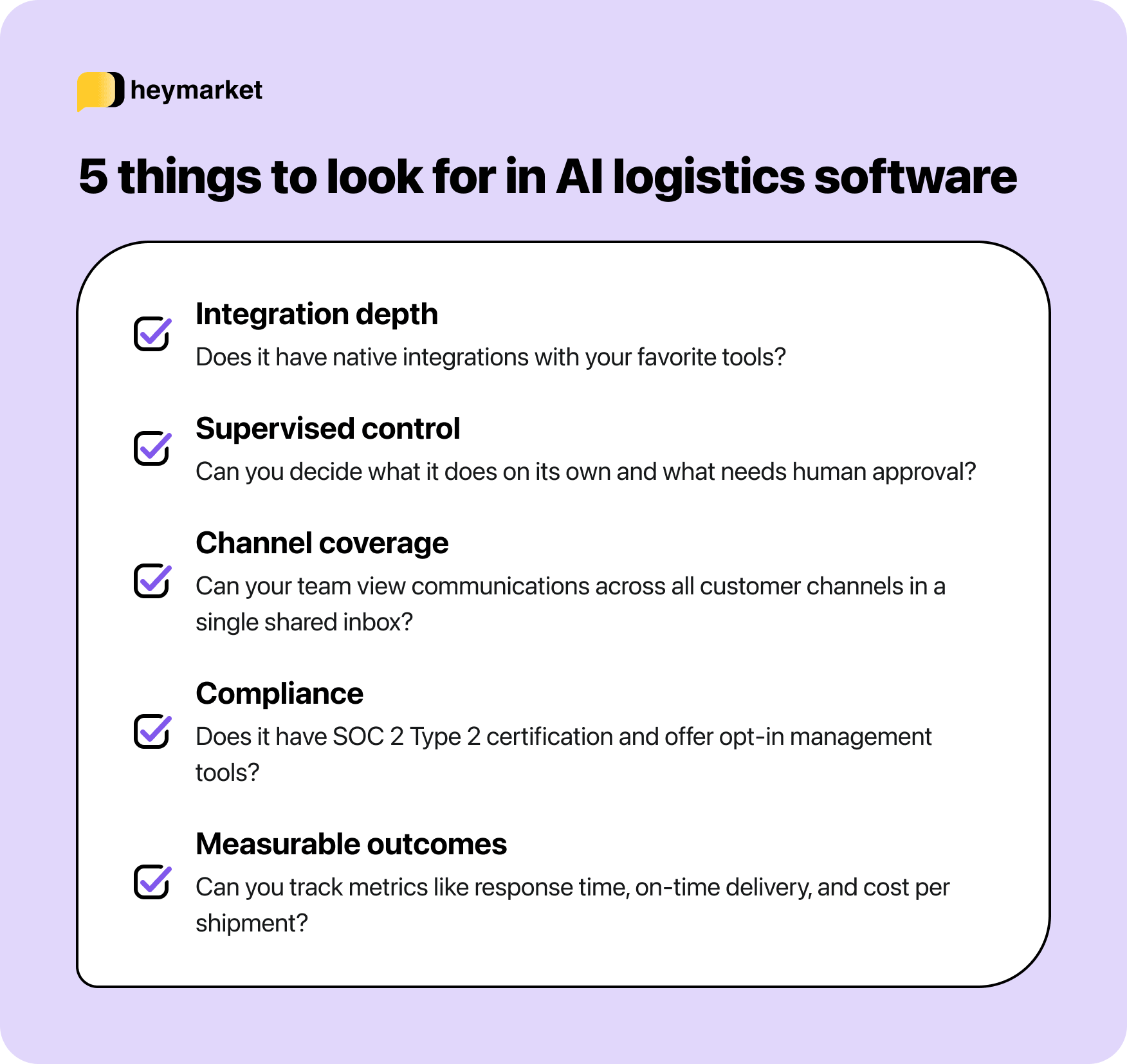
Look for five things in an AI agent platform for logistics: how deeply it integrates, how much control you keep, which channels it covers, whether compliance is built in, and how it measures results.
Here’s why these features are important:
- Integration depth: An agent that can’t pull data from your TMS, CRM, or order management system gives generic answers. Check for native integrations with the tools you already run.
- Supervised control: You should be able to decide what an agent does on its own and what needs human approval. Supervised modes let agents handle the routine while a person reviews edge cases.
- Channel coverage: Logistics communication spans SMS, email, and more. Look for a platform that brings it together in a shared inbox where your team sees every conversation in one view.
- Compliance: If agents are texting customers or drivers at volume, you need 10DLC registration, the U.S. carrier system for business texting, and A2P 10DLC handled correctly. Look for platforms with SOC 2 Type 2 and proper opt-in management.
- Measurable outcomes: The right tool measures itself against real metrics: on-time delivery, response time, cost per shipment.
How to get started with AI agents in logistics
Most teams see the best results when they start with one or two high-impact workflows and build from there.
- Audit your current conversations: Look at your highest-volume inbound messages—delivery questions, dispatch confirmations, recruiting replies—and find the ones that follow a pattern. Those are your best candidates.
- Pick one workflow: Start with something predictable and high-volume, like automated delivery notifications, where an agent can deliver value fast without a complicated setup.
- Connect your data sources: Agents act on the systems they connect to. Integrate your TMS, CRM, and order management so the agent has accurate data to work with.
- Set guardrails and go live: Define what the agent can do autonomously and what it routes to a person, then test before launch.
- Measure and expand: Track response times, on-time delivery, and ticket volume. Use what you learn to refine workflows and add new use cases.
Bringing AI agents into your logistics operation
A good logistics experience hinges on stellar communication. Tracking updates, dispatch coordination, driver messages, delivery exceptions. For every step, there’s a conversation that has to reach the right person at the right time.
That’s where a platform like Heymarket fits in. Heymarket gives your team a shared inbox for SMS, email, and other channels, with AI agents that handle the repetitive messaging while your people stay in control of exceptions.
Because it works inside your Salesforce integration and HubSpot, every conversation keeps its context instead of disappearing when the text thread ends. And with 10DLC, TCPA, and SOC 2 Type 2 compliance built in, you can manage that messaging volume the right way.
With Heymarket, your team manages more shipments and conversations at scale without losing the personal touch that keeps customers and drivers loyal.
If you’re looking for a platform that brings AI-powered messaging, automation, and omnichannel support together for logistics teams, Heymarket can help. Book a demo to see how it works.
FAQs about using AI agents for logistics
AI agents in logistics is still a relatively new space, and it’s common to have questions about how they work and where to start. Here are answers to some of the most frequently asked.
How does agentic AI improve supply chain management?
Agentic AI improves supply chain management by acting on data continuously and handling exceptions on its own. Instead of running fixed rules and escalating anything unexpected, agents reason about the current state of your operation, make a decision, and execute it across connected systems.
What are the best AI tools for logistics optimization?
For routing and inventory, look at agents that integrate with your TMS and warehouse systems. For communication at scale, look for a messaging platform with AI agents and a shared inbox that connects to your CRM. The right tool fits your existing systems, keeps you in control of what runs autonomously, and proves its value through real operational metrics.
How are AI agents different from traditional logistics automation?
Traditional automation executes fixed rules and escalates anything outside them. AI agents interpret context, handle exceptions, coordinate across multiple systems, and adapt to new data in real time.