One of your patients is halfway through a chaotic morning: kids, work, a prescription to pick up. Fifteen minutes before her appointment, she realizes she forgot it completely and didn’t receive a reminder to help her recall it. She won’t make it, and that slot is now empty.
AI patient engagement is the use of AI-powered workflows, agents, and chatbots to automate routine patient communication like reminders, follow-ups, scheduling, and common questions, across the channels your patients use. The result is fewer missed appointments, lighter administrative load, and a team with more time for your patients who need real attention.
Missed appointments alone cost the U.S. healthcare system an estimated $150 billion a year, at roughly $200 per empty slot. This guide covers the ins and outs of AI patient engagement: what it is, the challenges it solves, how the technology works, real examples, and what to know about HIPAA-compliant messaging.
Key takeaways about AI patient engagement
- AI patient engagement automates routine communication like reminders, follow-ups, and FAQs so staff can focus on patient care.
- It reduces two of the biggest drains on a practice: no-shows and administrative busywork.
- SMS is the highest-reach channel, and AI makes two-way texting possible at scale without adding headcount to your team.
- Patient messaging must be HIPAA-compliant, which depends on both the messaging platform’s safeguards and your team’s opt-in practices.
What is AI patient engagement?
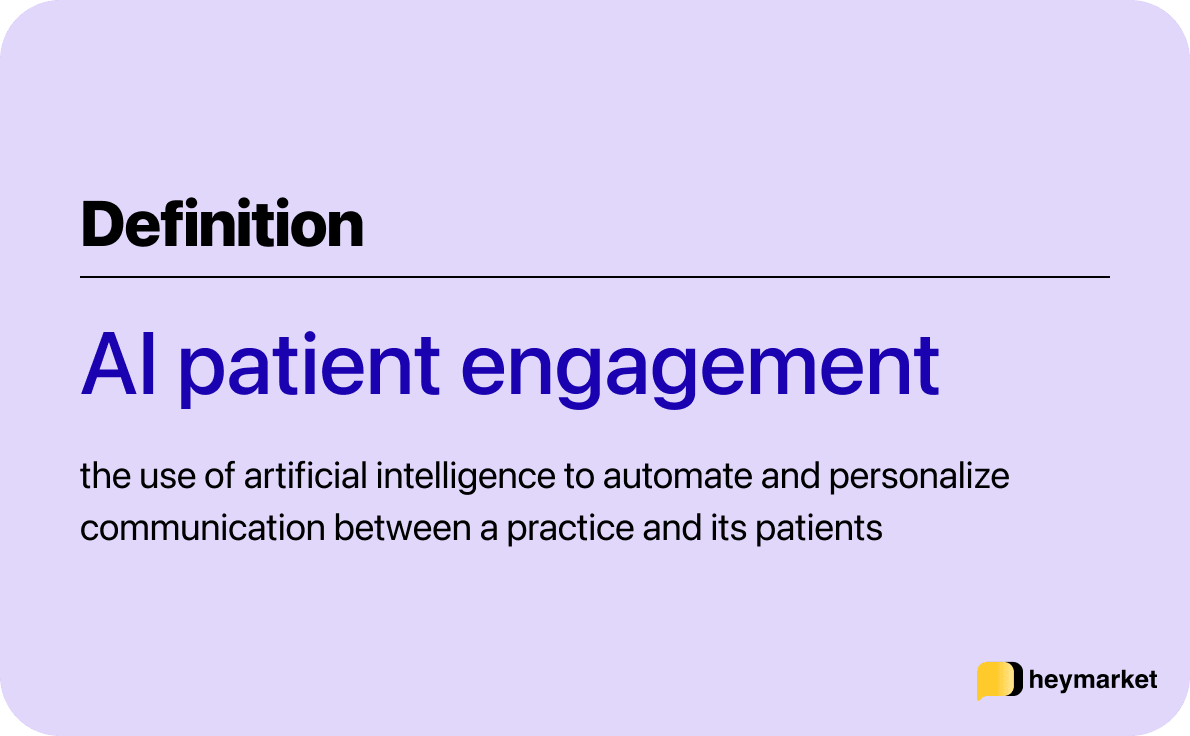
AI patient engagement is the use of artificial intelligence to automate and personalize communication between a practice and its patients. AI handles the repetitive, high-volume work such as appointment reminders, follow-up messages, and answering common questions, so your staff spends less time on the busywork and more time on patient care.
The role of AI in patient engagement is communication, not clinical decision-making. HIPAA-compliant SMS healthcare solutions work alongside your electronic health record and patient portal, helping reach patients where they are, then routing anything sensitive or complex to a team member.
What are the main challenges of AI patient engagement?
The main challenges of patient engagement are missed appointments, administrative burden on staff, reaching patients on channels they’ll answer, and staying consistent with follow-up between visits. Each one is solvable, and each is where AI earns its place:
- Missed appointments: No-show rates rose for 37% of medical groups in 2024, even as reminder tools grew, which is proof that one-way reminders alone don’t close the gap.
- Administrative burden: Physicians logged a 57.8-hour workweek in 2024, including 13 hours on indirect work like documentation and referrals. Every routine call your front desk fields comes out of that same stretched day.
- Reaching patients: Patients skip voicemails but read texts. In a randomized controlled trial, adding a text reminder cut the no-show rate from 38.1% to 23.5%; the channel you choose decides whether outreach lands at all.
- Consistent follow-up: Post-visit check-ins and re-engagement for overdue patients lose out to same-day work and quietly fall off. Automation keeps them from slipping.
Clinics turn to AI patient engagement for a reliable way to support patients across the full arc of care, from the moment someone books to the day they finish treatment, without stretching staff any thinner.
How AI workflows improve healthcare patient engagement
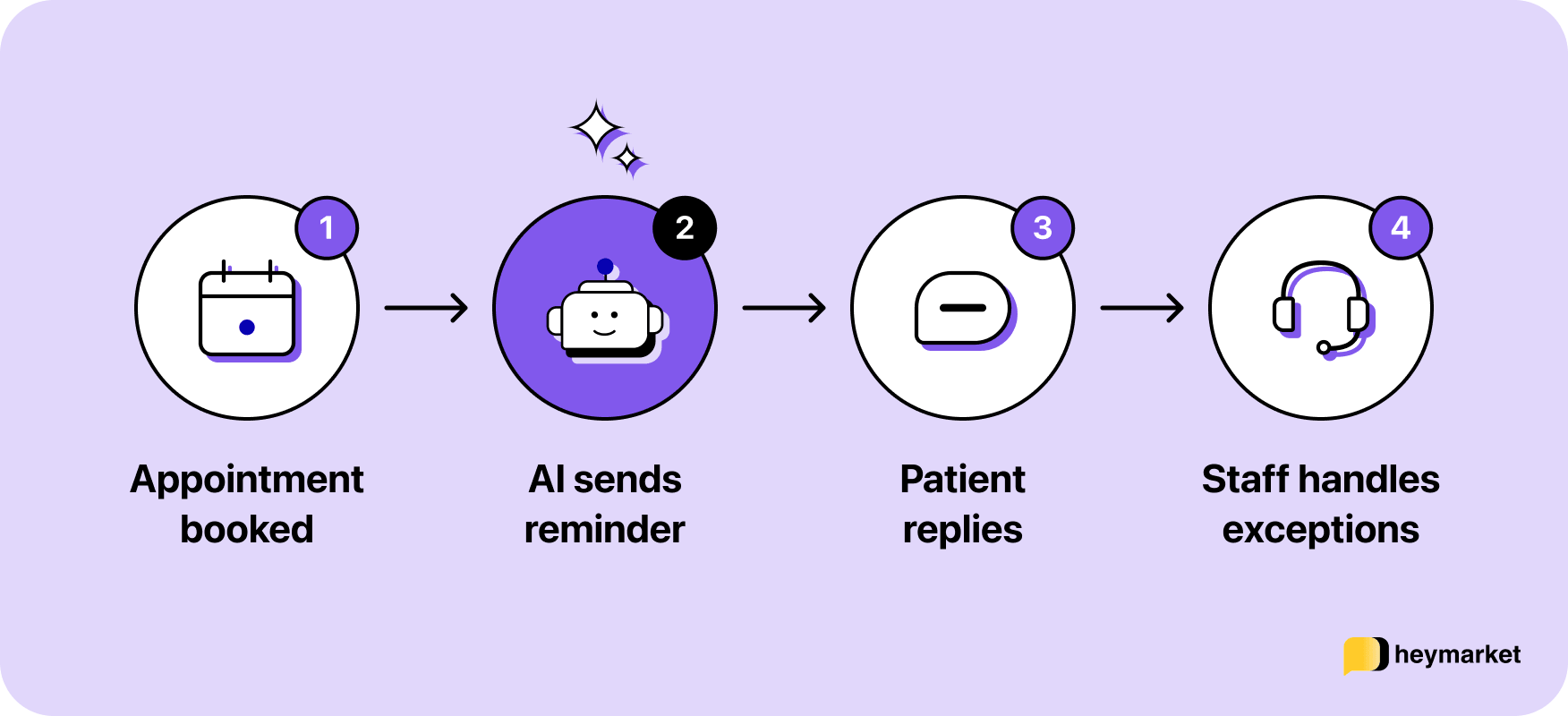
AI workflows improve healthcare patient engagement by automating the routine touchpoints, reminders, outreach, follow-ups, questions, and scheduling, while keeping your team in control of anything that needs a human. Here’s how that works across the five most common workflows:
1. Automated appointment reminders
Automated healthcare appointment reminders send timely, personalized texts before a visit and let patients confirm or reschedule by replying. Two-way reminders beat one-way ones because your patient can act on the spot, rather than calling the office during business hours.
With advanced automations, reminders trigger on a schedule and route replies to your team’s shared inbox, so a “can I move this?” becomes a reschedule instead of a no-show.
2. Conversational AI for patient outreach
Conversational AI for patient outreach handles two-way messaging campaigns at scale, recall reminders, wellness check-ins, seasonal outreach, and responds to replies in natural language through AI texting, email, or messaging. It reaches an entire patient list in minutes while still feeling like a one-to-one conversation.
3. Personalized patient follow-ups
Personalized patient follow-ups automate post-visit messages tailored to your patient and visit type, aftercare instructions, prescription-ready alerts, or a nudge to book the next appointment. Personalization comes from merge fields and patient data, so a message reads as specific rather than generic.
This is the workflow that practices most often drop by hand, and the one automation protects most reliably.
4. FAQ handling
FAQ handling lets AI agents answer the routine questions patients ask constantly, like hours, location, insurance, prep instructions, portal help, instantly and around the clock. Anything clinical or sensitive escalates to staff with the full conversation attached.
That keeps your front desk off repetitive calls without leaving patients waiting for an answer that never needed a person.
5. Scheduling and rescheduling
AI-assisted scheduling lets patients book, confirm, or move appointments through a text conversation instead of a phone queue. The system handles the back-and-forth and hands off to staff when a request falls outside the rules.
Because so many reschedule requests arrive after hours, automating this step recovers appointments that would otherwise quietly disappear.
Examples of AI for patient engagement
The clearest way to see AI patient engagement is by clinic type, since the highest-value workflow shifts with the practice. Here are three common setups:
- Multi-site primary care group: Before, front-desk staff at each location spent mornings on confirmation calls, and reminders still slipped through the cracks. After, automated two-way texts go out ahead of every visit, patients confirm or reschedule by replying, and only exceptions reach a coordinator. Staff reclaims the phone time, and empty slots get filled from a waitlist instead of sitting idle.
- Specialty practice: Before, post-visit follow-up depended on whoever remembered to call, so aftercare instructions and next-appointment prompts were inconsistent. After, follow-ups send automatically based on visit type, personalized with the patient’s details, so every patient leaves with clear next steps and a booked return visit.
- High-volume clinic or urgent care: Before, reception fielded a constant stream of the same questions—hours, insurance, prep, directions—while patients in the waiting room waited. After, an AI agent answers those routine questions instantly over text around the clock, freeing your team to focus on the healthcare customer service moments that need a human touch.
Across all three, the pattern holds: automation absorbs the repetitive volume, and your team keeps conversation history connected to each patient record through CRM integrations like Salesforce, so context never gets lost in the handoff.
What to know about HIPAA-compliant messaging
Texting patients is legal and HIPAA-compliant when both the platform and your practice do their part. The platform provides the technical safeguards; your team handles consent and access. Neither piece works without the other.
On the platform side, look for encryption in transit and at rest, role-based access controls, configurable data retention, and a business associate agreement (BAA). Make sure your messaging provider is HIPAA-compliant and SOC 2 Type 2 certified, and that a business associate agreement (BAA) is available on your plan.
On the practice side, patient opt-in is the non-negotiable step. Before anyone on your team texts a patient of yours, that patient has to agree to receive messages, and your platform should make managing those opt-ins straightforward.
One caution when you evaluate tools: a secure platform supports HIPAA compliance, but it doesn’t make you compliant on its own. Compliance is the combination of the right platform and the right internal practices around it.
What features should you look for in an AI patient engagement platform?
Look for six core features when choosing an AI healthcare and patient engagement platform. They fall into three groups: the compliance and security to handle patient data safely, the messaging and automation that do the outreach, and the reporting and integrations that keep everything connected to the systems you already run.
Each of the features below is integral for using AI in patient engagement workflows:
- HIPAA compliance and a BAA: Non-negotiable for any tool touching patient communication. Confirm encryption, access controls, and a signed BAA before anything else.
- Two-way messaging on the right channels: Patients should be able to reply, not just receive. Text is the baseline, with omnichannel messaging options like WhatsApp and webchat where patients prefer them.
- Automation for reminders and follow-ups: The platform should trigger messages on a schedule and by event, so routine outreach runs without staff effort.
- Human handoff: Every automated conversation needs a clean exit to a person, with full context passed to your team’s shared inbox.
- Engagement reporting: Tracking patient engagement means reporting on message delivery, reply rates, and response times—the signals that show whether your outreach is landing. It’s communication analytics, not clinical outcome tracking.
- Integration with your systems: A native Salesforce or HubSpot integration keeps patient data and conversation history where your team already works.
Give your team time back for patient care
Your team already knows which tasks eat up their time. The confirmation calls, the reminder voicemails, the same questions answered on repeat. AI patient engagement takes that routine volume off their plate, so their time goes to your patients who need them.
See how Heymarket helps healthcare teams reach patients over secure, HIPAA-compliant messaging: book a demo today.
AI patient engagement FAQs
Healthcare practices evaluating AI patient engagement tend to ask the same practical questions about compliance, staffing, tracking, and patient experiences. Here are answers to the ones that come up most, starting with the tracking question every administrator asks.
What tools or platforms are best for tracking patient engagement?
The best platforms for tracking patient engagement are two-way messaging tools that report on delivery, reply rates, and response times, and that are HIPAA-compliant with a BAA. Tracking here means communication metrics, whether patients open, read, and respond to your outreach, not clinical outcomes. Heymarket offers this kind of message-level reporting alongside a shared inbox, so your team can see what’s landing and follow up where it isn’t.
Is AI patient engagement HIPAA-compliant?
AI patient engagement is HIPAA-compliant when the platform provides the right safeguards and your practice manages patient consent. A HIPAA-compliant platform needs encryption, access controls, and a BAA, and your team needs documented opt-in before texting patients.
Does AI replace staff in patient communication?
No, AI doesn’t fully replace staff in patient communication. AI handles routine, repetitive messages so your staff can spend more time on the conversations that need clinical judgment or a personal touch. The handoff between automation and people is the point: automation covers volume, and your team covers care.
Can patients tell they’re texting with AI?
Patients often can’t tell they’re texting with AI, but the better question is whether the experience helps them. A well-built system answers accurately, keeps a natural tone, and hands off to a person the moment a question needs one, so patients get fast answers without feeling like a bot is blocking them from your team.