


Administrative work is eating into the time healthcare teams have for patients. Tasks like scheduling, documentation, billing follow-ups, and prior authorizations are an everyday part of most medical practices, but they don’t always need a person managing every step.
AI in healthcare operations has made it possible to automate many of these workflows, freeing staff to focus on work that requires more attention, like handling patient intake and processing requests for records. The result is an appointment schedule that stays on time and fewer miscommunications that frustrate patients.
But for that, you need the right platform—and that starts with understanding what tools can automate, how they connect to your existing systems, and whether they fit the workflows your team already relies on.
This guide covers where AI delivers value in healthcare operations, where to be cautious, and how to choose a solution that works for your practice.
How AI helps healthcare operations teams work more effectively
AI has proven incredibly useful for diagnosing conditions, analyzing medical imaging, and helping clinicians make more informed decisions. Operational AI tools take on the other side of healthcare: the administrative work that keeps a practice running day to day.
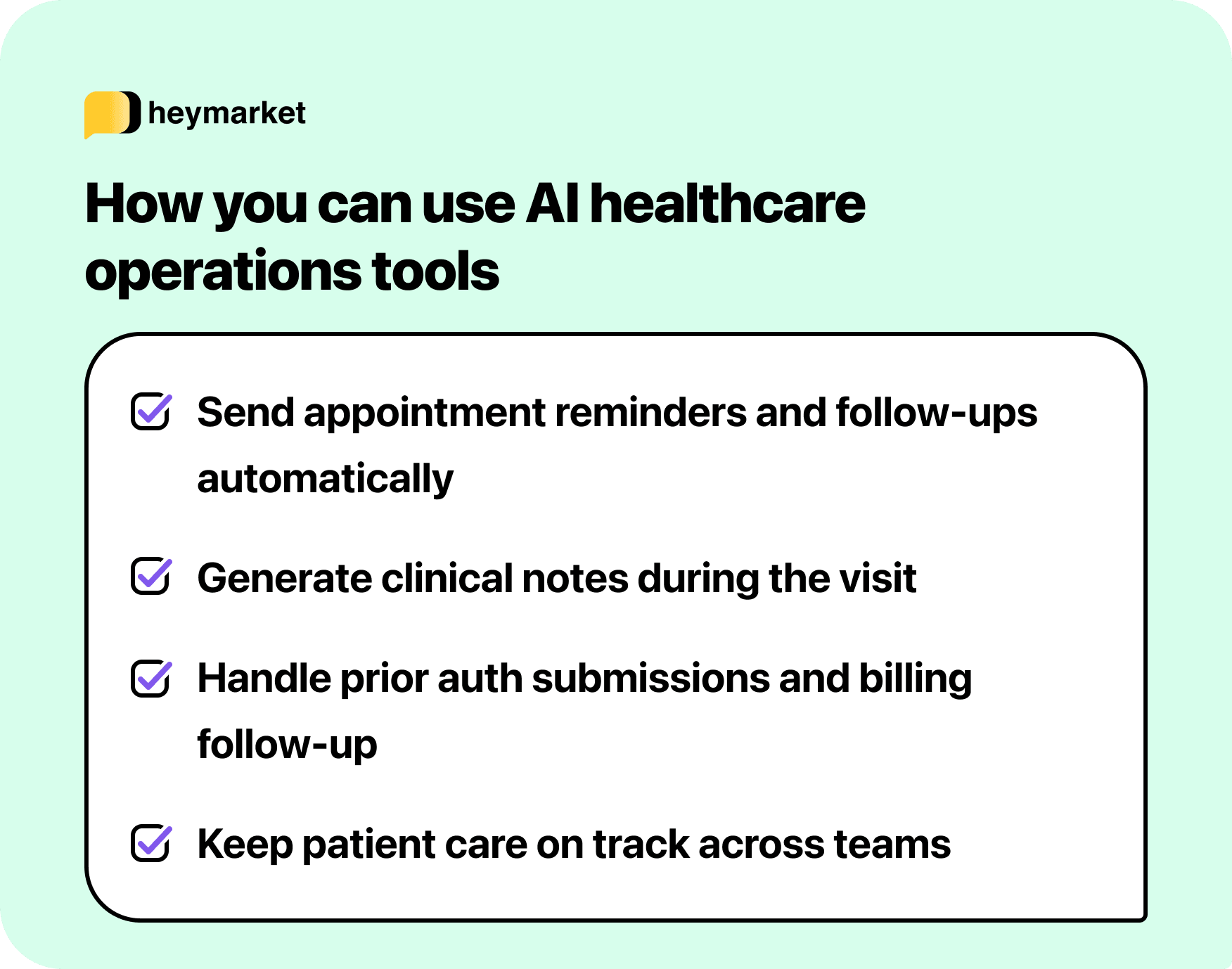
You’ll see AI used to help operations teams with:
- Clinical documentation: Providers can sometimes spend as much time on notes as they do with patients. Ambient scribing tools and AI-assisted note generation reduce post-appointment EHR time considerably, letting providers move directly to the next appointment without stopping to reconcile notes while the visit is still fresh.
- Patient communication: Staff in most care settings spend a significant portion of their day managing routine outreach, like confirming or rescheduling appointments and following up after visits. AI messaging tools for healthcare handle these exchanges automatically at whatever scale the practice requires, which means fewer no-shows and more consistent follow-up.
- Revenue cycle management: Prior authorization alone can consume hours of staff time per week, and that’s before factoring in claims preparation and denial follow-up. AI is taking on a growing share of this workload; 46% of hospitals have deployed AI in revenue cycle operations, improving coder productivity and reducing unbilled cases. Fewer denied claims means less revenue sitting in appeals and a more predictable cash flow into the practice.
- Care coordination: Managing transitions between departments, routing referrals, and following up on gaps in care involves a lot of back-and-forth that can fall through the cracks when handled manually. AI brings consistency to that process, ensuring no patient is lost between steps because a task wasn’t assigned, a message wasn’t sent, or a follow-up got buried.
Across all these workflows, the common thread is repetitive, rules-driven work that staff handles manually—which is exactly where AI historically works best. But modern AI tools can also go a step beyond conditional workflows with agentic AI.
Rather than triggering preset actions based on fixed criteria, agentic AI healthcare systems use judgment to handle multi-step tasks based on their context. That means initiating patient outreach, processing a response, and updating the record without staff managing each exchange. Human oversight remains part of the process, but they don’t have to remember to follow up or field routine questions every time.
However, giving agentic AI tools more autonomy also comes with increased risk.
Risks of using AI in healthcare operations
ECRI named AI-enabled health technologies the number one technology hazard of 2025, and for good reason. AI tools in healthcare introduce risks that don’t exist with most traditional software, so it’s important to understand what can go wrong before jumping headfirst into an AI-powered operations platform.
Some of the biggest concerns include:
- Accuracy and reliability: AI outputs are only as good as the data behind them. Models trained on incomplete or unrepresentative datasets can produce errors that are difficult to detect precisely because they happen at scale and without obvious flags. That might mean certain patient populations receiving inconsistent outreach, or scribing tools misidentifying medication that could put patient health at risk.
- Security and data privacy: Healthcare data is among the most sensitive and most targeted. AI platforms that weren’t built with healthcare-specific security requirements in mind may expose patient data when it’s stored, processed, or even unintentionally used in model training.
- Accountability and transparency: When AI takes actions autonomously, it can become difficult to trace why a decision was made or catch errors before they affect patients. Healthcare organizations remain legally and ethically responsible for AI-driven decisions regardless of what a vendor’s platform does, which makes explainability a necessity.
- Overreliance and deskilling: The more AI handles routine tasks, the easier it becomes to lose sight of the processes running underneath them. Staff who stop engaging with a workflow directly can lose the ability to catch errors or manage them when something goes wrong. Keeping humans actively involved in critical operations—rather than simply monitoring outputs—helps keep AI safer to use at scale.
While these risks come with some significant consequences, they’re not a reason to avoid using AI in healthcare operations. You just need to make sure you choose the right platform and implement it correctly, combining AI’s efficiency with human oversight and expertise where needed.
What to look for in an AI healthcare platform
Not every AI platform is built for healthcare, and not every healthcare AI platform will work for your specific practice. What matters is finding a tool that fits the way your team works—or the way you want them to work—and makes daily operations more manageable and consistent over time.
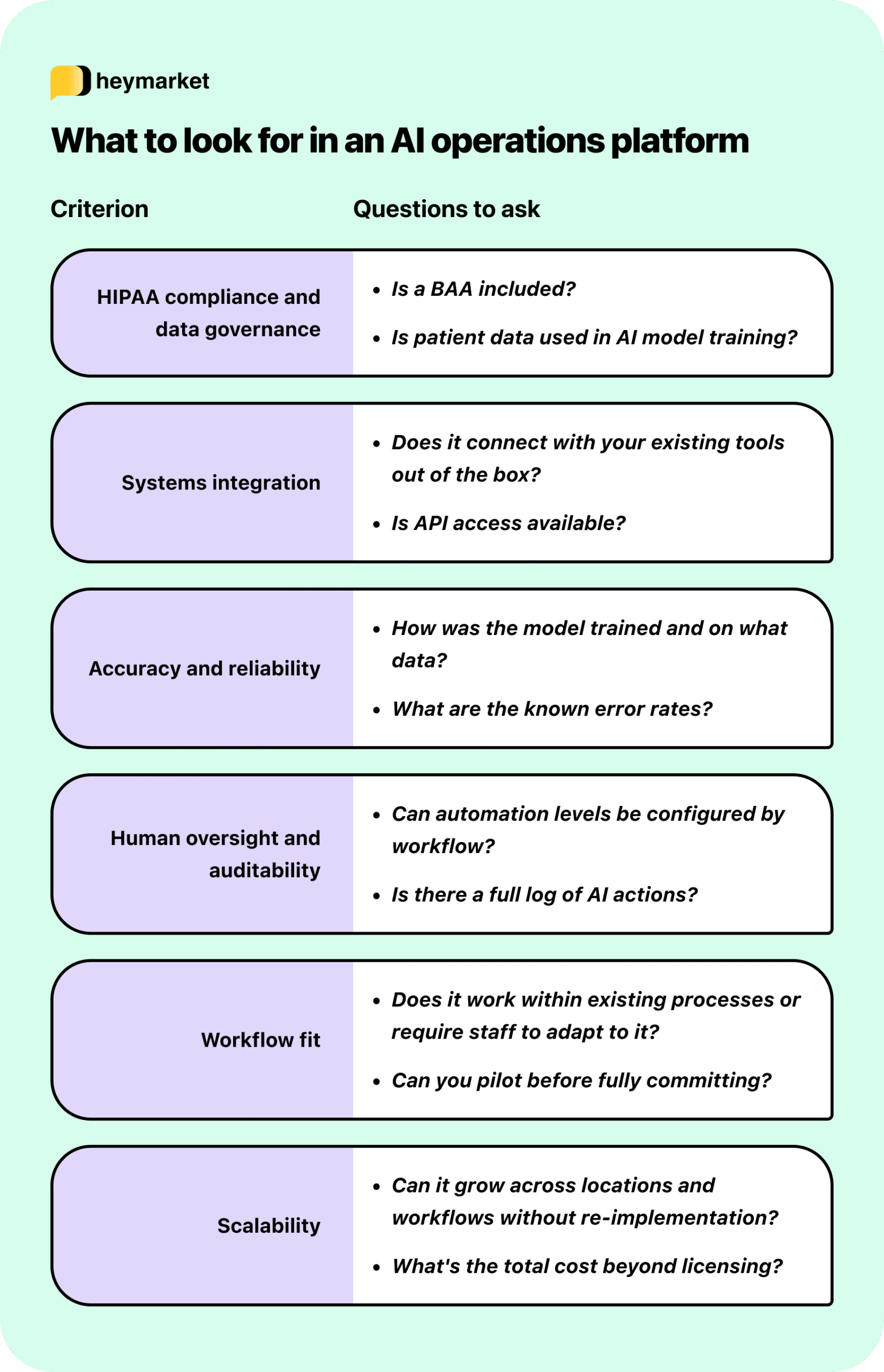
Evaluate each platform on these points to make sure your choice works for you, rather than forcing you to work around it.
HIPAA compliance and data governance
Healthcare data is subject to strict legal requirements around how it’s stored, accessed, and transmitted. Any platform handling patient information must be HIPAA-compliant and willing to sign a Business Associate Agreement.
A platform built for healthcare from the ground up will have data governance embedded in how it operates: patient data kept separate from other customers, strict controls over who can access it, and clear policies around whether PHI is used in AI model training. Ask vendors directly about each of these.
A platform that can’t answer specifically likely hasn’t built compliance into its foundation, which poses compliance and security risks your practice can’t afford.
Systems integration
A platform that doesn’t connect with the systems your team already uses creates more work. For operational tools like patient communication and scheduling, look for API connectivity and native integrations with the practice management, CRM, or billing systems your staff uses daily. The less setup integration requires, the faster the platform becomes useful—and the less it depends on dedicated IT resources to maintain.
Accuracy and reliability
AI tools are only useful if staff can trust what they produce. In an operational context, accuracy means the platform makes the right call consistently, like routing the right message, flagging the right follow-up, and generating a response that doesn’t need to be corrected before it goes out. When accuracy is low, staff end up reviewing every output manually, which defeats the purpose of automating the workflow in the first place.
Reliability is a separate question: does the platform perform consistently over time and across different scenarios? A tool that works well under normal conditions but produces errors when it encounters an unusual patient response or a billing exception isn’t reliable enough to run unsupervised at scale.
When evaluating both, ask whether the platform has been validated in settings comparable to yours. A model trained primarily on data from large hospital networks may have gaps when deployed in a smaller outpatient or specialty practice environment, where patient volumes, workflow patterns, and communication needs look different. Performance data from comparable settings gives you a more realistic picture of what to expect.
Human oversight and auditability
How much autonomy a platform exercises, and how visible that activity is to staff, matters as much as what it can automate. Look for platforms that make oversight configurable, including offering supervised modes for higher-stakes interactions and full automation for routine high-volume tasks like reminders, and that maintain a clear log of what actions the AI took and when. That record matters for compliance, for responding to patient issues, and for staying accountable when something goes wrong.
Workflow fit
The strongest predictor of long-term value is whether staff actually use the tool. A platform that forces teams to adapt to the system rather than the other way around tends to get abandoned, and that’s a significant implementation risk regardless of how capable the technology is.
Before committing, test it in one workflow and measure whether it’s something staff actually use. Asking the vendor for reference customers in similar practice settings will also give you a clearer picture of real-world fit than a sales demo will.
Scalability
AI platforms vary significantly in how well they hold up as usage grows. Start by evaluating whether the platform solves the immediate problem well. Then ask whether it can grow with the practice, as more users, more locations, and additional workflows are added, without requiring a full re-implementation. Unless you’re addressing a very specific need, you want an option that doesn’t limit what you can do in the future.
But don’t underestimate what expanding that platform can actually cost. Integration work, training, and ongoing maintenance also all add up as usage expands, so understanding the full cost picture before signing can help you avoid committing to a tool your practice can’t sustain.
Start with the problem, then find the tool
The practices that get the most out of AI in healthcare operations usually start with addressing a specific workflow problem rather than searching for the most feature-rich platform off the bat. The right AI solution is the one that fits your systems, works for your staff, and handles the workflows that are actually slowing your team down. Start there, validate it works, and build from that foundation with a tool that’s flexible enough to adapt to your growing needs.
For many outpatient clinics, private practices, and specialty groups, patient communication is the starting point. It’s generally lower risk than workflows that integrate and manage ePHI, and quickly saves administrative teams hours every week that can go towards improving patient satisfaction—without hurting the experience of the patients your AI platform interacts with.
If your team is spending significant time on appointment reminders, follow-ups, and billing outreach, Heymarket’s HIPAA-compliant messaging platform can help claw some back.
Book a demo today to learn more.