When your customer gets the same generic promo text as everyone else on your list after telling customer support what they’re shopping for, it can feel very impersonal. Omnichannel personalization tailors messages to customers across channels so they reflect their history with your brand instead of treating them like a stranger. The result is outreach that feels relevant instead of recycled.
This guide covers what omnichannel personalization means, its key components, the benefits, real examples, and how to implement it.
Omnichannel personalization key takeaways
- Personalization isn’t optional anymore: 71% of consumers expect companies to deliver personalized interactions, according to McKinsey.
- Omnichannel personalization tailors messages to customers across channels.
- The key components of this strategy are a unified customer view, consistent messaging across channels, and responsiveness to real behavior.
- Personalization improves engagement because relevant messages get more responses than generic ones.
- The best personalization tools connect directly to your CRM, so messages can reference real customer data automatically.
What is omnichannel personalization?
Omnichannel personalization means tailoring messages to individual customers across every communication channel.
Omnichannel and personalization work together, not separately. A connected channel with a generic message is still omnichannel, but it isn’t personalized. A personalized message sent through a disconnected channel isn’t omnichannel. Doing both is what makes a message feel like it’s from someone who knows your customer.
What are the key components of omnichannel personalization?
Omnichannel personalization rests on three components: a unified view of your customer, messaging that stays consistent across channels, and responsiveness to what your customer really does. Each one supports the others.
- A unified customer view: Every channel needs to pull from the same record—order history, past conversations, preferences—so a message can reference real details instead of guessing.
- Consistent messaging across channels: A personalized offer or answer should look and sound the same whether it arrives by text, email, or chat. Inconsistency undoes the trust personalization is supposed to build.
- Responsiveness to behavior: The best personalization reacts to recent customer action, such as an abandoned cart, a completed appointment, or a support question, rather than running on a fixed schedule regardless of context.
- AI-driven recommendations, where applicable: Some tools use AI to suggest the next best message or offer based on your customer’s data and behavior. This component varies significantly by platform, so confirm what any given tool’s recommendation engine draws from before assuming it applies to yours.
Get those three foundational pieces working together for personalization, and the fourth, AI-driven recommendations, becomes far more useful, since it has real customer data to draw from.
How does omnichannel personalization improve customer experience?
Omnichannel personalization improves customer engagement because relevant messages earn more attention and action than generic ones. The core benefits are:
- Higher response rates: A message tied to something real, like a recent order or an upcoming appointment, gets read and acted on more than a blanket promotion.
- Stronger loyalty: Personalization typically drives a 5 to 15% revenue lift, and McKinsey found that faster-growing companies generate 40% more of their revenue from it than slower-growing peers.
- Less wasted outreach: Messages built on real customer data are less likely to miss the mark entirely, which means fewer opt-outs and less noise for customers who don’t want to hear from you right now.
- Better customer lifetime value: Customers who feel understood are more likely to come back, and repeat customers are the ones personalization compounds the most for over time.
You don’t need to overhaul your whole customer experience to feel the benefits of omnichannel personalization. Even automating customer support for the two or three workflows that already generate the most volume—an order confirmation, a reminder, a follow-up—tends to produce a noticeable lift before a business builds out anything more elaborate.
Omnichannel personalization examples
The clearest omnichannel personalization examples show a business referencing something specific it already knows, automatically, wherever your customer is. A few common ones:
- A follow-up that references a real order: Your customer who bought a product two weeks ago gets a text checking in on that exact item, not a generic “how’s everything going” message. With merge fields pulling from the Salesforce integration, for example, that detail populates automatically instead of a rep typing it in by hand.
- An appointment reminder with real specifics: Instead of “you have an appointment tomorrow,” the reminder names the time, the service, and what to bring, because it’s pulling from the actual booking record rather than a generic template.
- A support reply that already has context: Your customer who emailed about a delayed order gets a text update on that same order without re-explaining it, because the conversation history carried over rather than starting fresh on a new channel.
- An AI-drafted response that reflects the full relationship: When a returning customer reaches out with a question, conversational AI can draft a reply that already reflects their order history and past conversations, so your rep reviews and sends instead of piecing the context together manually
Each of these runs on the same setup behind the scenes: connected data and a trigger that fires the message at the right moment. The next section breaks down how to build that for your own team.
How to implement omnichannel personalization
To implement omnichannel personalization, start with the data you already have, then automate the messages tied to your highest-volume customer actions (an order, a booking, a support request) rather than trying to personalize everything at once. Here’s a sequence that works for most mid-market teams:
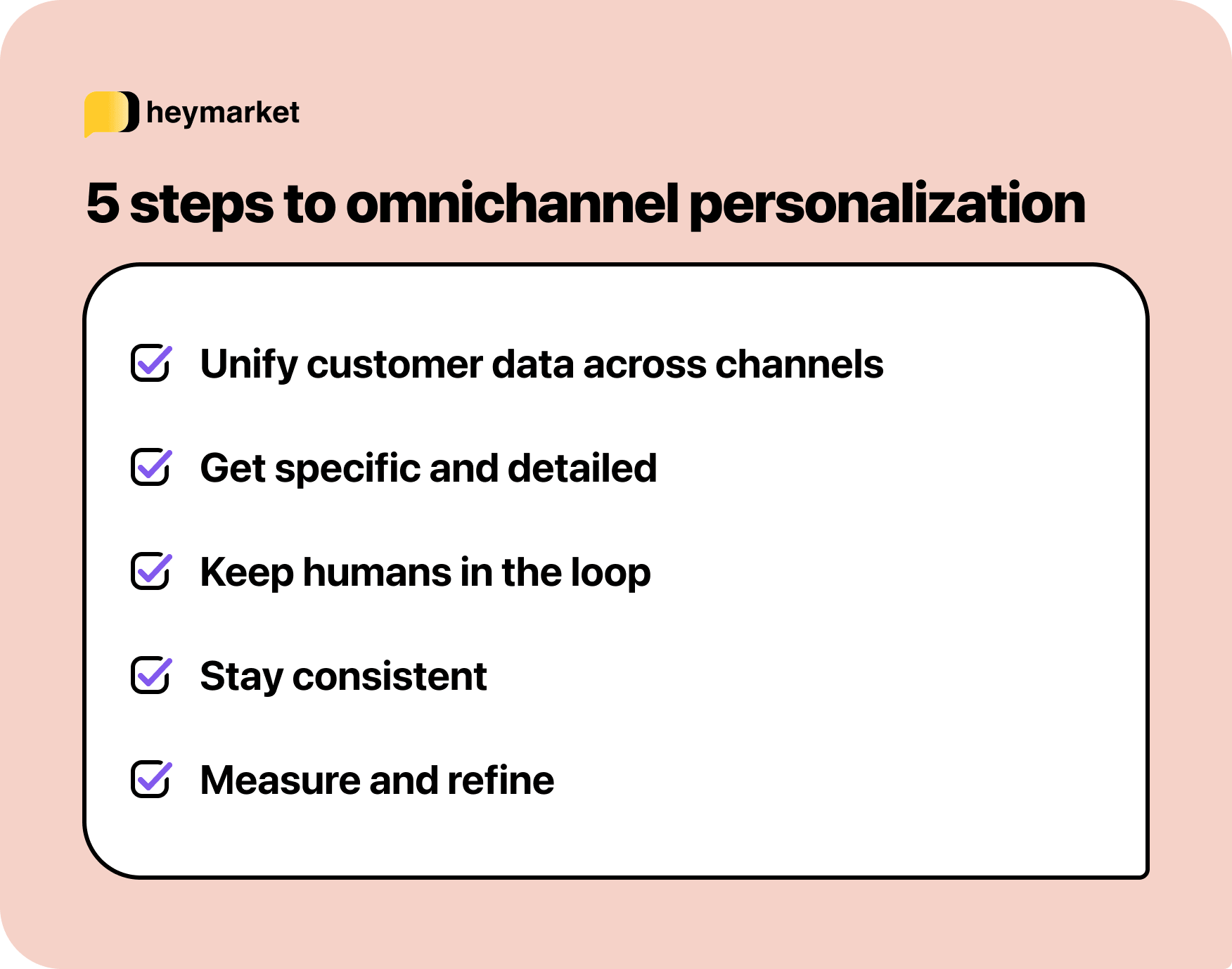
1. Unify your customer data across channels
Conversation history, order details, and contact info need to live in one place your whole team can see, rather than scattered across separate tools. Without this, your support rep can’t see what sales already told a customer, and personalization can break down.
Example: A customer who asked sales about pricing over text gets a support reply that references that conversation, instead of starting from zero.
2. Get specific
Focus on messages tied to actual events, an order, an appointment, or a completed purchase. A message built on something concrete is more likely to land well.
Example: A post-purchase follow-up references the specific item bought, not a generic “thanks for your order.”
3. Keep a human in the loop for judgment calls
Automate the routine moments, but route anything sensitive, emotionally charged, or unusual to your team, with the full context attached. This is also where invasive-feeling personalization gets caught before it reaches your customer. Referencing a recent order is helpful, but referencing something a customer wouldn’t expect you to know can feel unsettling instead of thoughtful.
Example: A billing question that touches on a customer’s financial hardship routes to a person instead of an automated response, even if the account details are on file.
4. Stay consistent across every channel
A personalized customer experience on one channel and a generic one on another breaks the continuity that makes personalization work for your customers in the first place. Whatever tone and detail your customer gets by text should carry over if they switch to email or chat.
Example: A customer who gets a personalized order update by text shouldn’t get a blanket “check your account” email if they follow up on a different channel.
5. Measure engagement and refine
Track response rates and adjust which moments you personalize and how, rather than setting it up once and leaving it alone. What counts as relevant shifts as your customer’s behavior changes, so this isn’t a one-time setup.
Example: If reminder texts get high response rates but promotional follow-ups don’t, that’s a signal to automate more of the former and rethink the latter.
When you’re choosing a tool for this, look for native CRM integration so data flows automatically, merge fields for message-level personalization, automation triggers tied to real behavior, and clear handoff to a person when a conversation needs one. AI data enrichment can also help keep all customer data up-to-date so personalization never uses incorrect information.
Make every message feel like it’s about your customer
Personalization works if the data behind it is accurate and connected, which is exactly what an omnichannel setup provides. Layer the two together, and every message feels genuine and like it came from someone paying attention to your customers’ needs.
See how Heymarket connects your channels and your customer data in one shared inbox: book a demo.
Omnichannel personalization FAQs
As you’re evaluating omnichannel platforms, you’ll likely run into questions about what makes one capable of real personalization. Here are the questions we hear most often, starting with which tools are worth a look.
What tools are best for omnichannel personalization?
When researching omnichannel personalization tools, look for a platform with native CRM integration, merge fields for message-level detail, automation triggers based on real behavior, and AI drafting support that pulls from customer history.
Is omnichannel personalization only for large enterprises?
No, any business with customer data and more than one channel can personalize messages at that scale; the tools that make it possible are built for mid-market teams, not just large ones.
How is personalization different from just using someone’s first name?
A first name in a template is basic personalization; omnichannel personalization draws on real behavior and history, like a recent order or a past conversation, and stays consistent across every channel your customer uses.