


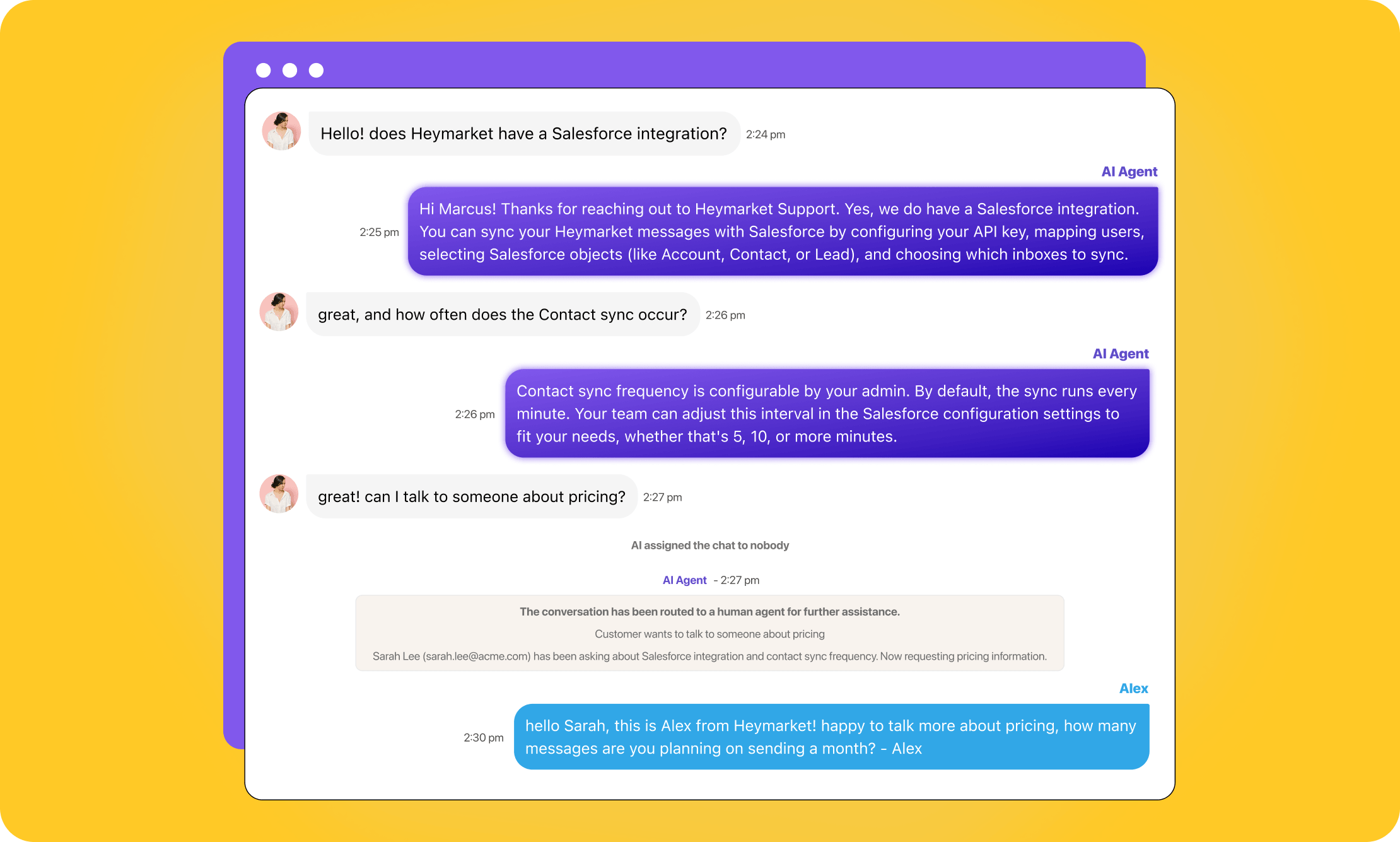
Building AI agents that can solve real customer problems is a rewarding challenge. As the Heymarket team built our own AI agent, it was also a chance for us to learn about how to prepare AI agents for the dynamic, real-world conversations your customers bring to the table.
At Heymarket, we decided to find out if our agents were ready the only way that felt right: by using them to handle our very own customer support.
The agents we’re building
Heymarket’s AI agents are built to autonomously handle customer questions across SMS and other messaging channels. Each agent is equipped with a deep understanding of our own processes, product documentation, and the telephony industry—so it can provide accurate, relevant answers without human intervention. What sets them apart is context awareness: the agent follows the full arc of a conversation, not just a single message, allowing it to respond the way a knowledgeable team member would.
Why we used Heymarket’s AI agents first
We knew that for our AI agents to be successful, it had to work in actual customer conversations. Real-life chats don’t follow patterns. Customers bring unique questions, spontaneous feelings, and a natural expectation for accuracy. A tool might look great in a controlled test, but the real magic happens when it manages a busy afternoon of incoming texts and emails.
By routing our own support messages through our new AI agent, we gained something a demo could never provide: authentic feedback from real people in real-time.
Tracking our agents’ progress
To keep our progress steady, we established a collaborative routine. Every Monday and Thursday, our team gathered to review the AI’s performance. We focused on three simple questions to help us tell the story of its growth:
- What percentage of messages did the agent send perfectly without any human editing?
- How many responses needed a quick, human polish from our team?
- When did we decide to step in and handle things personally?
These numbers gave us a concrete way to see the agent getting better every day and helped us decide exactly where to focus our energy next.
Turning challenges into opportunities
The real “aha!” moments happened when we looked closely at individual chats. Sometimes the tone felt a little robotic, or the AI pulled facts from an old help article.
Interestingly, we discovered that when the agent missed the mark, it was often because our own documentation was a bit outdated. This was a fantastic opportunity to tidy up our Help Center, ensuring our human customers and our AI were both getting the best information possible. Each little hiccup became a training session that made the whole system stronger.
Building confidence, one chat at a time
Over several weeks, we followed a simple cycle: measure, review, adjust, and repeat. We weren’t looking for instant perfection; we were building reliability. We wanted an agent that handled the majority of tasks beautifully, knew exactly when to ask a human for help, and always sounded like “us.”
Eventually, something shifted. Our team stopped second-guessing the AI and started trusting it. That confidence didn’t come from a manual, but from watching the agent succeed, learning from its mistakes, and seeing it win our team’s belief through a pattern of evidence. Now, we’re excited to help your team build that same level of trust and success.
What’s coming next
We’re also building AI lead nurturing agents to engage prospects who come through our landing pages. These agents will respond to inbound inquiries in real time, answering questions to help determine whether Heymarket is the right fit for a prospect’s messaging needs — moving conversations forward without requiring a human to be available at every moment.